Spiritual Despondency, Vanity of Vanities, Foolishness to the World, and Paradoxical Truths

It is rare for me to take notes during Mass. But today I did. The priest began his homily by referencing a book that he then encouraged us to read. The book is by Kathleen Norris and is called Acedia & me: A Marriage, Monks, and a Writer’s Life. The book is described on Amazon as “a personal and moving memoir that resurrects the ancient term acedia, or soul-weariness, and brilliantly explores its relevancy to the modern individual and culture.” Here is an excerpt from an excerpt on the meaning of the term and its significance in illuminating the nature of a struggle with spiritual despondency:

At its Greek root, the word acedia means the absence of care. The person afflicted by acedia refuses to care or is incapable of doing so. When life becomes too challenging and engagement with others too demanding, acedia offers a kind of spiritual morphine: you know the pain is there, yet can’t rouse yourself to give a damn. That it hurts to care is borne out in etymology, for care derives from an Indo-European word meaning “to cry out,” as in a lament. Caring is not passive, but an assertion that no matter how strained and messy our relationships can be, it is worth something to be present, with others, doing our small part. Care is also required for the daily routines that acedia would have us suppress or deny as meaningless repetition or too much bother.

The first reading at Mass today was from Ecclesiastes:

Vanity of vanities, says the Teacher, vanity of vanities! All is vanity. What do people gain from all the toil at which they toil under the sun? A generation goes, and a generation comes, but the earth remains forever. The sun rises and the sun goes down, and hurries to the place where it rises. The wind blows to the south, and goes around to the north; round and round goes the wind, and on its circuits the wind returns. All streams run to the sea, but the sea is not full; to the place where the streams flow, there they continue to flow. All things are wearisome; more than one can express;  the eye is not satisfied with seeing, or the ear filled with hearing. What has been is what will be, and what has been done is what will be done; there is nothing new under the sun. Is there a thing of which it is said, “See, this is new”?  It has already been, in the ages before us. The people of long ago are not remembered, nor will there be any remembrance  of people yet to come by those who come after them.

Right after explaining acedia and reminding us of the first reading, the priest said:
“I am a celibate priest. Have you ever heard of anything more stupid than that?”

It was a striking thing to say. He continued, “Genesis tells us that we are made for community… Ecclesiastes tells us that ‘all is vanity’… I could have made a lot more money. But when you become conscious of emptiness and brokenness and then come to see this emptiness and brokenness in the light of the gospel, we begin to pray earnestly the prayer of the psalmist who prays: “So teach us to number our days that we may get a heart of wisdom.”

Briefly this priest discussed Alcoholics Anonymous and how the process of moving from brokenness to freedom in fellowship with others that is so emphasized in the Twelve-Step Program is really quite like every soul’s journey of return to God.

The Christian message is foolishness to the world explains St. Paul:

For the message about the cross is foolishness to those who are perishing, but to us who are being saved it is the power of God. For it is written, “I will destroy the wisdom of the wise, and the discernment of the discerning I will thwart.” Where is the one who is wise? Where is the scribe? Where is the debater of this age? Has not God made foolish the wisdom of the world? For since, in the wisdom of God, the world did not know God through wisdom. […] For God’s foolishness is wiser than human wisdom, and God’s weakness is stronger than human strength. Consider your own call, brothers and sisters: not many of you were wise by human standards, not many were powerful, not many were of noble birth. But God chose what is foolish in the world to shame the wise; God chose what is weak in the world to shame the strong; God chose what is low and despised in the world, things that are not, to reduce to nothing things that are, so that no one might boast in the presence of God. He is the source of your life in Christ Jesus, who became for us wisdom from God, and righteousness and sanctification and redemption, in order that, as it is written, “Let the one who boasts, boast in the Lord.”

G.K. Chesterton, in his chapter “The Paradoxes of Christianity” wrote, “It is my only purpose in this chapter to point this out; to show that whenever we feel there is something odd in Christian theology, we shall generally find that there is something odd in the truth.

This is important to bear in mind when reading the lives of the Saints. For example, St. Teresa of Avila writes: “The Lord told me once that it wasn’t obedience if I wasn’t resolved to suffer, that I should fix my eyes on what He suffered, and that all would be easy.” This profound desire for communion with God lead her to resolve, “I need no rest; what I need is crosses.”

Searching for purpose in this life, we often aim for success of the worldly variety. Every day I am asked dozens of time what I will do next in this life. “The human mind may devise many plans, but it is the purpose of the Lord that will be established,” says a proverb.

I am a flower quickly fading
Here today and gone tomorrow
A wave tossed in the ocean
Vapor in the wind
Still You hear me when I’m calling
Lord, You catch me when I’m falling
And You’ve told me who I am
I am Yours, I am Yours
– Casting Crowns lyrics “Who Am I?”

It is easy to doubt God’s purposes. They are so foolish in a dark world that has not been illumined by the light of Christ. But Christ has come, is come, and will come again. And, as the priest today concluded, “[A life in Christ] surpasses any other ways in which we could move toward a fullness of life.”

Reflecting on Huizinga and Guardini on Playfulness

This semester I am taking a class called “War and Interpretation”. According to the syllabus, “[…We] begin with the assumption that war is a natural human activity and, as with all such activities, has a variegated historical, political, and cultural significance. […] The objective is to provide an opportunity to engage the intellect with several distinct perspectives on a major expression of one of the constant attributes of human nature.”

While my political science degree requirements include: International Relations; Comparative Politics; and Research Methods, Henry Adams said, “Knowledge of human nature is the beginning and end of political education.” My friend Thomas Cliplef says, “Generally, I find [the quantitative] side of political science very boring as it tells me nothing about the human condition in relation to politics. It doesn’t attempt to grasp the internal perspectives of the leadership or the citizens within a political community. The qualitative or philosophical side of political science does just this.”

And so, when I am annoyed with the efforts to beat out any normativity in students in a statistics class, I find it refreshing to retreat to my class on war.

For this class, I recently read a book called Homo Ludens by Johan Huizinga.

Here are some of the important things that Huizinga says about play:

– First and foremost, then, all play is voluntary activity.” (7)
– As regards its formal characteristics, all students lay stress on the disinterestedness of play. (9)
– Play is distinct from ‘ordinary’ life both as to locality and duration. (9)
– [Play] creates order, is order. (10)
– Play has a tendency to be beautiful. (10)
– All play has its rules. (11)
– The function of play in the higer forms which concern us here can largely be derived from the two basic aspects under which we meet it: as a contest for something or as a representation of something. (13)
– Let us enumerate once more the characteristics we deemed proper to play. It is an activity which proceeds within certain limits of time and space, in a visible order, according to rules, freely accepted, and outside the sphere of necessity or material utility. The play-mood is one of rapture and enthusiasm, and is sacred or festive in accordance with the occasion. A feeling of exhalation and tension accompanies the action, mirth and relaxation follow. (132)
– More often than not [the task of a hero] will be tackled as the result of a challenge, or a vow, a promise or whim of the beloved. All these motifs carry us straight back to agnostic play. (133)

Huizinga analyzes play in language, law, war, knowing, poetry, mythopoiesis [myth-making], philosophy, art, and contemporary civilization. What I found most interesting is the relationship between Huizinga’s thoughts on play and those of Romano Guardini in the his chapter “The Playfulness of the Liturgy” within his larger work The Spirit of the Liturgy. Huizinga makes very brief mention of Guardini’s work, but it was enough of a mention to spark my interest in considering the relationship between the play-element in its essence, at which Huizinga aims to strike, and the play-element in the liturgy and in the sacraments, that is Guardini’s focus.

What Huizinga seems to emphasize that Guardini does not is the voluntary nature of play. There is a strong emphasis on the freedom and spontaneity in play, combined with a lack of necessity. What Guardini seems to emphasize that Huizinga does not about the essence of play is that is it, at once, meaningful and purposeless. He says that “to be at play, or to fashion a work of art in God’s sight–not to create, but to exist–such is the essence of the liturgy.”

Early on, Huizinga discusses the nature and significance of play, from children’s games to sacred performances:

The sacred performance is more than an actualization in appearance only, a sham reality; it is also more than a symbolical actualization – it is a mystical one. In it, something invisible and inactual takes beautiful, actual, holy form. The participants in the rite are convinced that the action actualizes and effects a definite beatification, brings about an order of things higher than that in which they customarily live. All the same this ‘actualization by representation’ still retains the formal characteristics of play in every respect. It is played out or performed within a ground that is literally ‘staked out’, and played moreover as a feast, i.e. in mirth and freedom.

For such a general description, the above passage certainly coincides with the theology of the Eucharist. In the Blessed Sacrament, the invisible God takes “beautiful, actual, holy form”. According to the catechism, “the power of the words and the action of Christ, and the power of the Holy Spirit, make sacramentally present under the species of bread and wine Christ’s body and blood, his sacrifice offered on the cross once for all.”

Huizinga continues:
“The rite produces the effect which is then not so much shown figuratively as actually reproduced in the action. The function of the rite, therefore, is far from being merely imitative; it causes the worshippers to participate in the sacred happening itself.”

This makes sense with the re-incarnation of Christ in the Blessed Sacrament. Christ becomes present again, not represented, but re-present “in the flesh” in the mystery of the Eucharist.

The congregation participates fully in the sacred happening. Consider the words of the priest: “By the mystery of this water and wine may we come to share in the divinity of Christ, who humbled himself to share in our humanity.” After the institution narrative, the congregation says the Memorial Acclamation: “We proclaim your death, O Lord, and profess your resurrection, until you come again.” The priest acting In persona Christi constitutes what Huizinga references Marett as calling “‘a helping-out of the action.'”

Staying focused on why this matters at all, let’s entertain Huizinga’s conviction about the centrality of play in civilization. He says, “For many years the conviction has grown upon me that civilization arises and unfolds in and as play.” He argues this forcefully saying, “Play cannot be denied. You can deny, if you like, nearly all abstractions: justice, beauty, truth, goodness, mind, God. You can deny seriousness, but not play.”

If Huizinga is right about this, then he is offering an important insight into human nature. We humans are not only knowers, makers, producers, consumers, etc. We are players. This sort of thinking inspires me to remember what my friends and family often remind me: “You are a human being, not a human doing!” This is where Guardini’s analysis is helpful because he strikes at the nature of man as being ordered to live in relationship with God. The meaningfulness lies in the soul’s nature “not to create, but to exist” This has meaning for understanding human dignity apart from achievement.

Guardini says:

It is in this very aspect of the liturgy that its didactic aim is to be found, that of teaching the soul not to see purposes everywhere, not to be too conscious of the end it wishes to attain, not to be desirous of being over-clever and grown-up, but to understand simplicity in life. The soul must learn to abandon, at least in prayer, the restlessness of purposeful activity; it must learn to waste time for the sake of God, and to be prepared for the sacred game with sayings and thoughts and gestures, without always immediately asking ‘why?’ and ‘wherefore?’ It must learn not to be continually yearning to do something, to attack something, to accomplish something useful, but to play the divinely ordained game of the liturgy in liberty and beauty and holy joy before God.

It is natural, when discussing play, to consider what can be learned from children. “Truly I tell you, unless you change and become like children, you will never enter the kingdom of heaven.” (Matt. 18:3) In discussing child’s play, Guardini explains what he means by saying that play is purposeless, yet meaningful:

The child, when it plays, does not aim at anything. It has no purpose. It does not want to do anything but to exercise its youthful powers, pour forth its life in an aimless series of movements, words and actions, and by this to develop and to realize itself more fully; all of which is purposeless, but full of meaning nevertheless, the significance lying in the unchecked revelation of this youthful life in thoughts and words and movements and actions, in the capture and expression of its nature, and in the fact of its existence. And because it does not aim at anything in particular, because it streams unbroken and spontaneously forth, its utterance will be harmonious, its form clear and fine; its expression will of itself become picture and dance, rhyme, melody and song. That is what play means; it is life, pouring itself forth without an aim, seizing upon riches from its own abundant store, significant through the fact of its existence. It will be beautiful, too, if it is left to itself, and if no futile advice and pedagogic attempts at enlightenment foist upon it a host of aims and purposes, thus denaturizing it.

These two authors may be discussing play a bit differently. I am still not sure about the essence of play, though I agree with the various characteristics that are enumerated.

With the emphasis on existence, we can return to Huizinga’s reference of Aristotle with regard to play. Aristotle, discussing music (which Huizinga places in the category of play), says that “music conduces to virtue in so far as, like gymnastics, it makes the body fit, breeds a certain ethos and enables us to enjoy things in the proper way[.]”

On this note, a friend of mine recently asked, referring to our mutual friend, why this friend would feel obligated to go to Mass every single day. “As the body needs food, so the soul needs food,” I said. Specifically, I meant the Bread of Heaven.

Recently I read a quotation from Cardinal Basil Hume in the Mystery of the Incarnation. He writes:

The meaning of things, and their purpose,
Is in part now hidden
But shall in the end become clear.
The choice is between
The Mystery and the absurd.

Participating in the Holy Mass is an opportunity to enter into the Mystery. The daily grind is what has my heart echoing St. Teresa of Avila’s words: “Lord, what can I do here? What has the servant to do with her Lord? What has earth to do with heaven?” But then, at the Mass we pray. The priest says, “And so, with all the choirs of angels in heaven we proclaim your glory and join in their unending hymn of praise…” The congregation joins saying:

Holy, Holy, Holy Lord,
God of hosts.
Heaven and
earth are full of your glory.
Hosanna in the highest.
Blessed is he who
comes in the name of the Lord.
Hosanna in the highest.

There is a distinct presence in the moment, combined with participation in eternity. The universal Church is praying and there seems to be a timelessness. Before receiving the Blessed Sacrament we say, “Lord, I am not worthy that you should enter under my roof, but only say the word and my soul shall be healed.” Here we are echoing the words of the Roman centurion in the Gospel of Matthew. And so, from a return to biblical accounts, to “heaven kissing earth” in the Eucharist, to the foretaste of heaven through joining the choirs of angels, we participate in this “great processional order of existence in a sacred play, in and through which [each participant] actualizes anew, or ‘recreates’, the events represented and thus helps to maintain the cosmic order.”

One of my favorite parts of the Mass goes as follows:

Priest:
The Lord be with you.
People: And with your spirit.
Priest: Lift up your hearts.
People: We lift them up to the Lord.
Priest: Let us give thanks to the Lord our God.
People: It is right and just.

What I like so much about this part is that it inspires me to contemplate the meaning of justice. Also, thinking of justice in terms of the thanks due to God according to the dignity of His Nature and Goodness inspires a good notion of justice to imitate in community with others. Pope Benedict has written some interesting things about justice and resurrection.

According to this article summarizing the arguments, Fr. James Schall writes:

As the pope cites him, [Theodore] Adorno maintains that, even though he does not believe it, the only ‘logical’ way that there ever could be true justice in this actual world would be for there to be something like the resurrection of the body. Clearly he is right. There is, no doubt, something amusingly ironic about a Marxist
philosopher appearing prominently in a papal encyclical as an upholder of the basic Christian doctrine of the resurrection of the body.

At the end of Huizinga’s book, he says:

So that by a devious route we have reached the following conclusion: real civilization cannot exist in the absence of a certain play-element, for civilization presupposes limitation and mastery of the self, the ability not to confuse its own tendencies with the ultimate and highest goal, but to understand that it is enclosed within certain bounds freely accepted. Civilization will, in a sense, always be played according to certain rules, and true civilization will always demand fair play. Fair play is nothing less than good faith expressed in play terms. Hence, the cheat or the spoil-sport shatters civilization itself. To be a sound culture-creating force this play-element must be pure. It must not consist in the darkening or debasing of standards set up by reason, faith or humanity. It must not be a false seeming, a masking of political purposes behind the illusion or genuine play-forms. True play knows no propaganda; its aim is in itself, and its familiar spirit is happy inspiration.

Do we play purely? Is it true that “the liturgy has laid down the serious rules of the sacred game which the soul plays before God”? Could being “spiritual but not religious” be akin to being a “spoil-sport”? Is constituting an end-in-itself the very essence of play? If play is marked by its set apartness from ordinary life and play is a good-in-itself, then is play the aim of life? Is leisure the “basis of culture” as Joseph Pieper called it? (In the same vein as Aristotle, as Huizinga shows.) Can the play-element help us to focus on the goodness and beauty of existence? For human persons, does the goodness of our existence lie (or live?) within rather than outside of us?

“Now what is the meaning of that which exists? That it should exist and should be the image of God the Everlasting. And what is the meaning of that which is alive? That it should live, bring forth its essence, and bloom as a natural
manifestation of the living God.” – Romano Guardini

“Looking at” International Relations

This semester, I am taking a class called “Introduction to International Relations.” This class is a requirement for my degree in political science at the University of Calgary. In An Inquiry into the Nature and Causes of the Wealth of Nations, Adam Smith makes a compelling argument against compulsory classes:

“The discipline of colleges and universities is in general contrived, not for the benefit of the students, but for the interest, or more properly speaking, for the ease of the masters. Its object is, in all cases, to maintain the authority of the master, and whether he neglects or performs his duty, to oblige the students in all cases to behave to him as if he performed it with the greatest diligence and ability. It seems to presume perfect wisdom and virtue in the one order, and the greatest weakness and folly in the other. Where the masters, however, really perform their duty, there are no examples, I believe, that the greater part of the students ever neglect theirs. No discipline is ever requisite to force attendance upon lectures which are really worth the attending, as is well known wherever any such lectures are given.

During this first week of classes, professors have been quick to lower the standards. Examples of this include such statements as:

“Please don’t ask me for an extension, but you will anyway.”

“Instead of refusing to accept late assignments, you will instead lose three points per day for your late assignment.”

“This was part of your assigned reading, if you bothered at all to look at it.”

“Most of you do not want to be here, but are required to take this class.”

The professors who are the most demanding consistently command the greatest respect. Additionally, as Adam Smith notes, students also tend to rise to the challenge.

On excellent professor of mine said, “In this often impersonal, bureaucratic university, I want you to know that you students in this class are my primary responsibility for this semester and that I am available to guide you to the best of my ability throughout this course.”

This comment inspires students to strive for excellence and the students have a teacher whose example is worthy of imitation.

Since I have only taken two classes in my first introductory course in International Relations, I do not know very much about this sub-discipline. And so, this brief reflection is based on my initial impression of International Relations as a field of studies.

I perused the assigned textbook. From the outset, the authors say that they prefer to use the term “world politics” instead of international relations. What is politics? Since politics is derived from the Greek word polis, politics was classically and fundamentally about the affairs of the polis, or city-state (as we tend to translate it). What then is meant by “world politics”? The term in Greek would be “cosmopolis.”

According to Wikipedia, the source of this phrase can be traced to Diogenes of Sinope who, when asked where he came from, answered, “I am a citizen of the world (kosmopolitês).”

“Cosmopolitan” is defined as follows:

“Cosmopolitanism is the ideology that all human ethnic groups belong to a single community based on a shared morality. Cosmopolitanism may entail some sort of world government or it may simply refer to more inclusive moral, economic, and/or political relationships between nations or individuals of different nations. A person who adheres to the idea of cosmopolitanism in any of its forms is called a cosmopolitan or cosmopolite.”

While the professed purpose of the class is to provide students with an overview of several ideologies in international relations, I wonder about the extent to which the textbook being centered around “world politics” favors the cosmopolitan one.

Very often the problems of international relations are presented as questions of “either/or” when the truer account likely involves the word “and.” (E.g., Individual AND community.) If we resist systematic thinking, we are likely to find that the good of the individual and the common good are not actually in such severe tension as we might expect.

Edmund Burke grasps this interplay when he discusses “little platoons“:

“To be attached to the subdivision, to love the little platoon we belong to in society, is the first principle (the germ as it were) of public affections. It is the first link in the series by which we proceed towards a love to our country, and to mankind.”

Perhaps there could be an implicit “and” between the words “world politics.” Eric Voegelin begins his six volume work Order and History as follows:

“God and man, world and society form a primordial community of being. The community with its quaternarian structure is, and is not, a datum of human experience. It is a datum of experience insofar as it is known to man by virtue of his participation in the mystery of its being. It is not a datum of experience insofar as it is not given in the manner of an object of the external world but is knowable only from the perspective of participation in it.”

Voegelin goes on to discuss the nature of human existence acknowledging that “man is not a self-contained spectator”, [but rather…] “an actor, playing a part in the drama of being and, through the brute fact of his existence, committed to play it without knowing what it is.”

Aiming to consider how “world politics” might make any sense, I began to consider that perhaps “world”, as an abstract noun relates to the mystery, to the idea beyond our full grasp and “politics” is connected to our direct experience, to our participation in “little platoons”.

Peter Kreeft makes a helpful distinction between abstract and concrete nouns that I find relevant to this discussion. He says:

“Humanity” does not go with “God” (“God and humanity”) because “God” and “man” are concrete nouns, like “dog” and “cat”, while “divinity” and “humanity” are abstract nouns, like “caninity” and “felinity” or “dogginess” and “cattiness.”

From Voegelin talking about the “quaternarian structure” of being including “God and man, world and society”,  he seems to be stressing the totality of being including the immanent and the transcendent.

On the first day of class, the professor discussed certain theories of International Relations, much like the overview given in the textbook. He mentioned such theories as idealism, realism, and Marxism. What is meant by theory? According to the Oxford English Dictionary, the etymology the word is derived from Greek and means “looking at”. Upon reading this, I immediately recollected C.S. Lewis’s “Meditation in a Toolshed“. In this essay, Lewis draws a distinction between “looking at” and “looking along” an experience.

I encourage you to read the excellent two-page essay. Here is an excerpt:

As soon as you have grasped this simple distinction, it raises a question. You get one experience of a thing when you look along it and another when you look at it. Which is the “true” or “valid” experience? Which tells you most about the thing? And you can hardly ask that question without noticing that for the last fifty years or so everyone has been taking the answer for granted. It has been assumed without discussion that if you want the true account of religion you must go, not to religious people, but to anthropologists; that if you want the true account of sexual love you must go, not to lovers, but to psychologists; that if you want to understand some “ideology” (such as medieval chivalry or the nineteenth-century idea of a “gentleman”), you must listen not to those who lived inside it, but to sociologists.

It seems that the entire aim of international relations is to “look at” ideologies. But we are not outside of international relations and beyond ideology. We are participants in the world. What would it be to “look along” international relations? Does a United Nations bureaucrat truly “look along” INTERNATIONAL RELATIONS or, does he (at best) “look along” perhaps interpersonal relations? It is easy to employ anthropomorphic language to abstract entities, but what do we learn about politics then? What do we learn from this about human nature and the affairs of the city?

As Lewis argues, “looking along” must precede “looking at” because “You discount them [the phenomena in question] in order to think more accurately. But you can’t think at all – and therefore, of course, can’t think accurately – if you have nothing to think about.

Furthermore, he maintains:

“[It] is perfectly easy to go on all your life giving explanations of religion, love, morality, honour, and the like, without having been inside any of them. And if you do that, you are simply playing with counters. You go on explaining a thing without knowing what it is. That is why a great deal of contemporary thought is, strictly speaking, thought about nothing – all the apparatus of thought busily working in a vacuum.”

It is quite early for me to make any judgments about International Relations (or World Politics), but these are the initial issues that come to mind.

Rather than “either/or” approaches, let us try to insert the word “and” in order to gain a broader view.

If we are assigned the task of choosing “one system” through which to “look at” an issue in current affairs, I do not see how this would be a very profitable exercise. Eric Voegelin was paraphrased in an Introduction to his book The New Science of Politics as encouraging people with the words, “Don’t be an Ism-ist!” When it seems that International Relations becomes a course in Ism-ism, I will try to resist the constraint of system construction and adoption. It is a temptation to make this substitution for thinking.

The textbook for my class even defines a theory in this manner. It says:

“A theory is a kind of simplifying device that allows you to decide which facts matter and which do not.”

The world is more complex and we are in it and so we cannot “look at” things perfectly, but we ought to try to sharpen the vision we get through the lens of our experiences of “looking along.”

Today I was discussing war and battle with some classmates. We had been reflecting on the idea that a soldier does not choose to die for his country, but rather lays down his life for a friend, for the guy next to him. “Looking at” war and “looking along” battle offer two different perspectives and both are important to gaining insight into the broader picture.

Dr. John von Heyking succinctly says, “Politics really is about the myriad of one-to-one relationships among people getting things done; politics is about friends helping friends.” International Relations seems be to ordinary politics what macro economics is to micro economics. Ultimately, the former in both cases is merely an effort to understand the aggregate of experiences “looked along” in the experiences of the latter.

Politics is about human action. Only humans act. Relating is a human action performed between persons, not between nations.

And so ends a hasty analysis of Week 1. I invite your comments.

Blessed are those who do not “work the room”

Today the second reading at Mass struck me.

Here it is:

“My brethren, show no partiality as you hold the faith of our Lord Jesus Christ, the Lord of glory.

For if a man with gold rings and in fine clothing comes into your assembly, and a poor man in shabby clothing also comes in,

and you pay attention to the one who wears the fine clothing and say, ‘Have a seat here, please,’ while you say to the poor man, ‘Stand there,’ or, ‘Sit at my feet,’

have you not made distinctions among yourselves, and become judges with evil thoughts?

Listen, my beloved brethren. Has not God chosen those who are poor in the world to be rich in faith and heirs of the kingdom which he has promised to those who love him?” James 2:1-5

In a room there is a common temptation to scan the room for the so-called important people. The failure to resist this temptation often leads to someone dismissing one conversation partner so that he or she can “work the room.”

A friend with whom I volunteered at a lofty dinner event lamented that one of the other student volunteers turned her back on her mid-sentence to shake the hand of someone who she determined to be more worthy of her time.

Sometimes it seems that adults will follow the person with the most dignified title or position in a foolish manner comparable to how small children will all chase after a soccer ball in a cluster.

The above reading challenges us to recognize the equality in the sanctity of each person. While we can respect certain offices and authorities, ultimately we should be able to shake someone’s hand in a similar spirit of respect and charity whether that person is the prime minister or a person outcasted by much of society.

Mother Teresa was able to do her good work because she said, “I see the face of Christ in one of his more distressing disguises.”

A friend of mine named Laura Locke reflects on this topic very beautifully. She writes:

“Why is it that we so often feel drawn to people on the other end of the spectrum?  We give our attention to the powerful, the good-looking, the rich, the talented, the confident ones who are very successful at looking after themselves.  I guess we naturally lean towards people whom we secretly strive to be – and who strives to be an outcast?  But Jesus invites us to follow in his footsteps, to walk with him down the dusty back roads, seeking the people that normally garner no one’s attention.”

The gospel is filled with paradoxes. This is true of philosophy also and very untrue of ideology.

It is interesting to reflect on the different experiences of community from an informal gathering sharing coffee and donuts with strangers after church to the experience of attending a political convention which tends to consist in swapping business cards and credentials. There is something to learn from both and really from any experience with others. However, I think it is important to balance these sorts of experiences so as to not become blinded by the partiality mentioned in scripture.

At every mass the congregation says, “I confess to Almighty God and to you my brothers and sisters that I have sinned through my own fault….” Whereas, at political events we tend to essentially find a way to say, “I profess to you my colleagues and acquaintances that I have succeeded through my own achievement…”

The more that we derive our sense of identity from what we do rather than who we are, the more challenging it is for us to see the instrinic dignity of others.

Young people are often encouraged to network so that they can “get ahead”, but this seems to be a perverse notion of relationship. Instead, let us be encouraged to love one another so that we can get to heaven. I think that the authenticity of the latter will bear more fruit both in this life and the next.


Alberta Government Funds Private Abortion Clinics with 16.5 Million Dollars Annually

The Canadian Institute for Health Information (CIHI) annually releases statistics on induced abortions in Canada. Alberta has the greatest disparity in Canada between clinic abortions and hospital abortions. According to clinic manager Kim Cholewa, clinics bill Alberta Health Services approximately $1,600 to terminate a pregnancy.[i] In 2009, according to the CIHI, 78.6% of abortions in Alberta are performed in for-profit, private clinics.[ii] Multiplying the cost that clinics charge Alberta Health Services to perform abortions, we have private clinics being funded to the tune of $16,534,400 for their activity based on 2009 numbers.[iii]

In addition to significant government funding to private clinics when healthcare is already consuming 39% of the provincial budget,[iv] there is also a problem with disclosure in other jurisdictions. For example, clinic reporting of both the numbers of abortions and the cost in British Columbia is voluntary. There is no legislative requirement to report, despite the clinics being funded by the Government of British Columbia. The lack of disclosure from clinics means that the extent to which the government is publicly funding these clinics remains unknown to taxpayers.

According to the CIHI report, “Hospitals are mandated by their provincial/territorial ministry of health to report all hospital activity (not limited to abortions); therefore coverage of abortions performed in Canadian hospitals can be considered to be complete. However, there is no such legal requirement for clinics to report their activity (reporting is voluntary) [and this is why data is often incomplete].”[v]

Clinics that are independent, have no obligation to report their data, and that operate for-profit should not be funded with the limited provincial healthcare dollars.

If private clinics continue to be funded with public dollars, then they should be held to the same reporting and disclosure standards as hospitals.

But I ask: How would you reallocate the 16.5 million dollars annually being spent by the Alberta government on abortions?

– Amanda Achtman


[i] Simons, Paula. “Simons: Alberta should stop stalling, start funding Essure birth-control.” Edmonton Journal, October 11, 2011. Accessed November 1, 2011. Article archived here: http://www2.canada.com/edmontonjournal/news/archives/story.html?id=57816457-0bde-439e-97f2-195e979fbf0d&p=2

[ii] Canadian Institute for Health Information. “Induced Abortions Performed in Canada in 2009.” Accessed November 1, 2011. http://www.cihi.ca/CIHI-ext-portal/pdf/internet/TA_09_ALLDATATABLES20111028_EN.

[iii] Ibid.

[iv] Government of Alberta. “Budget summary by ministry.” Accessed November 1, 2011. http://alberta.ca/acn/201102/2995902%20BudgetSummarybyMinistry_Budget2011%20-%20Final.pdf.

[v] Canadian Institute for Health Information. “Induced Abortions Performed in Canada in 2009.” Accessed November 1, 2011. http://www.cihi.ca/CIHI-ext-portal/pdf/internet/TA_09_ALLDATATABLES20111028_EN.

Books that have been recommended to me this summer 2012

The following list is a list of book recommendations that I received over the past few months. I am grateful to everyone whose recommendations have led to the compilation of this list. Feel free to leave further recommendations below in the comments section.

The Education of Henry Adams by Henry Adams
How to Read A Book
by Mortimer J. Adler
The Canadian Founding: John Locke and Parliament by Janet Ajzenstat
The Political Thought of Lord Durham by Janet Ajzenstat
The Human Condition by Hannah Arendt
The Origins of Totalitarianism by Hannah Arendt
“The Crisis in Culture: Its Social and Its Political Significance” by Hannah Arendt
The Opium of the Intellectuals by Raymond Aron
City of God by Saint Augustine
De Ordine by Saint Augustine
The Life of Teresa of Jesus: Autobiography by Teresa of Avila
Le Père Goriot by Honoré de Balzac
Relativism: Feet Firmly Planted in Mid-Air by Francis J. Beckwith and Greg Koukl
Propaganda by Edward Bernays
Love and Friendship by Allan Bloom
Colloquium of the Seven by Jean Bodin
I and Thou
by Martin Buber
The Wreck of Western Culture: Humanism Revisted by John Carroll
Shadows on the Rock by Willa Cather
Don Quixote by Miguel de Cervantes
Faith and Liberty: The Economic Thought of the Late Scholastics by Alejandro A. Chafuen
Witness by Whittaker Chambers
The Ball and the Cross by G.K. Chesterton
“The Ballad of the White Horse” by G.K. Chesterton
On Loving God by Bernard of Clairvaux
“Instruction Dignitas Personae on Certain Bioethical Questions” by Congregation for the Doctrine of the Faith
Beyond Politics by Christopher Dawson
Progress and Religion: An Historical Inquiry by Christopher Dawson
Religion and the Modern State by Christopher Dawson
The Idiot by Fyodor Dostoyevsky
The Possessed by Fyodor Dostoyevsky
The Brothers Karamazov by Fyodor Dostoyevsky (Pevear and Volokhonsky trans)
Alchemists of Loss: How modern finance and government intervention crashed the financial system by Kevin Dowd and Martin Hutchinson
Aims of Education by T.S. Eliot
“Little Gidding” by T.S. Eliot
Progress and Poverty by Henry George
“‘The computer does not impose on us the ways it should be used'” by George Grant
The Fall of the Faculty: The Rise of the All-Administrative University and Why It Matters by Benjamin Ginsberg
The Fault in Our Stars by John Green
The End of the Modern World by Romano Guardini
Being and Time by Martin Heidegger
Catch-22 by Joseph Heller
Les Misérables by Victor Hugo
Clash of Civilizations by Samuel Huntington
The School of Salamanca by Marjorie Grice-Hutchinson
Against the Heresies by Irenaeus
Modern Times by Paul Johnson
Selfish Reasons to Have More Children by Brian Kaplan
Toward a More Natural Science: Biology and Human Affairs by Leon Kass
Fear and Trembling by Søren Aabye Kierkegaard
The Sickness Unto Death by Søren Aabye Kierkegaard
Two Ages: A Literary Review by Søren Aabye Kierkegaard
A Program for Conservatives by Russell Kirk
Enemies of the Permanent Things by Russell Kirk
Creating the Kingdom of Ends by Christine M. Korsgaard
The rage of Edmund Burke: portrait of an ambivalent conservative by Isaac Kramnick
A Grief Observed by C.S. Lewis
Surprised by Joy by C.S. Lewis
That Hideous Strength by C.S. Lewis
The Great Divorce by C.S. Lewis
After Virtue by Alasdaire MacIntyre
The Politically Correct University: Problems, Scope, and Reform edited by Robert Maranto, Richard E. Redding, and Frederick M. Hess
The Seven Storey Mountain by Thomas Merton
Planned Chaos by Ludwig von Mises
Utopia, The Perennial Heresy by Thomas Molnar
Thus Spoke Zarathustra by Friedrich Nietzsche
Will it Liberate? by Michael Novak
The Democratic Spirit of Capitalism by Michael Novak
Wise Blood by Flannery O’Connor
Lost in the Cosmos: The Last Self-Help Book by Walker Percy
Leisure as the Basis of Culture by Josef Pieper
Hippias by Plato
Laws by Plato
The Tacit Dimension by Michael Polanyi
How to Read by Ezra Pound
Christianity and the Crisis of Cultures by Joseph Ratzinger
A Humane Economy: The Social Framework of the Free Market by Wilhelm Ropke
Philosophy of Religion by Fulton J. Sheenam
Blood and Thunder by Hampton Sides
A Billion Bootstraps: Microcredit, Barefoot Banking, and The Business Solution for Ending Poverty by Philip Smith and Eric Thurman
One Day in the Life of Ivan Denisovich by Aleksandr Solzhenitsyn
The Gulag Archipelago by Aleksandr Solzhenitsyn
“The Nobel Prize in Literature 1970 Award Speech” by Aleksandr Solzhenitsyn
Justice by Michael Sandel
What Money Can’t Buy: The Moral Limits of Markets by Michael Sandel
The Theory of Moral Sentiments by Adam Smith
Velvet Glove, Iron Fist by Christopher Snowdon
Potency and Act, Studies Toward a Philosophy of Being by Edith Stein
Natural Right and History by Leo Strauss
The Malaise of Modernity by Charles Taylor
Walden by Henry David Thoreau
Waldo by Paul Theroux
Judith by Aritha Van Herk
Mavericks: An Incorrigible History of Alberta by Aritha Van Herk
Audacious and Adamant: The Story of Maverick Alberta by Aritha Van Herk
Becoming Human by Jean Vanier
“Liberalism and Its History” by Eric Voegelin
“In Search of the Ground” by Eric Voegelin
The Hare with Amber Eyes by Edmund de Waal
After Ideology: Recovering the Spiritual Foundations of Freedom by David Walsh
The Growth of the Liberal Soul by David Walsh
The Modern Philosophical Revolution: The Luminosity of Existence by David Walsh
Guarded By Mystery: Meaning in a Postmodern Age by David Walsh
Leaves of Grass by Walt Whitman

Break the Conventions. Keep the Commandments – Highlights of the Chesterton Conference

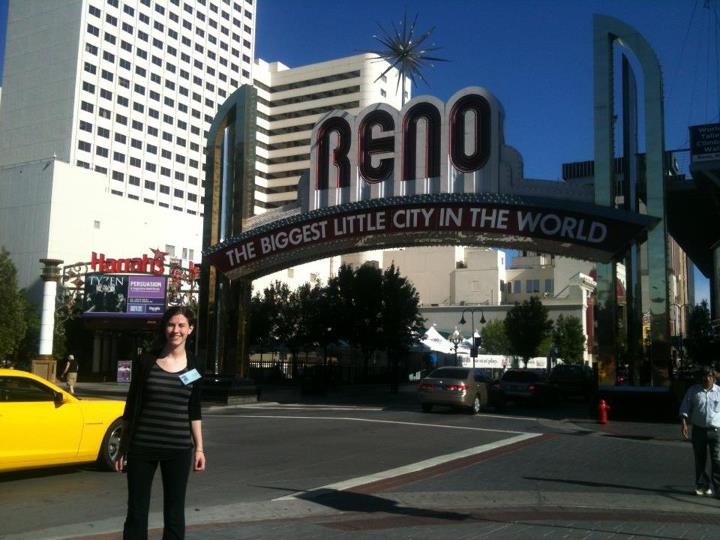
Before arriving to Reno, my only impression of it had been what I had gleaned from a couple of scenes in the film Sister Act. I landed in the Reno-Tahoe airport after arriving from Birmingham. A local in the airport advised me against my plan to take a cab and find a hostel for the night.  She said, “Reno’s hurtin’ bad. Take a free shuttle downtown and you can stay at a hotel for $35.” Praise God for putting locals in every single city I visit.

I took the shuttle to Circus Circus hotel and was told that the room would be $47, plus tax and plus some additional fee. For a hotel room it wasn’t bad, but I thought that I could do better. When I said I might go down the street and compare prices, they dropped the price $10 and I checked into the hotel.

I had arrived to Reno two days early for the 31st Annual G.K. Chesterton Conference taking place at the Silver Legacy Hotel and Casino. After settling into my hotel, I strolled the streets of downtown Reno observing the hotels, restaurants, movie theatre, and street names.

On August 1, I woke up and soon after phoned Joan and Michael who agreed to host me during the conference. I arrived to their home on Wednesday afternoon. Asked if I’d like a drink, I said yes and Mr. Cassity offered to make me a martini! As we drank our martinis we discussed liberal arts education, great books, tradition, conversion, conservatism, travel, and more. Mrs. Cassity made a delicious dinner and served wine. I was well taken care of by my Chestertonian host parents.

The next day, they offered to take me to Lake Tahoe. I am so glad that they did. It was a beautifully scenic drive. They told me that their children can ask themselves in the same day whether they’d like to go skiing or golfing. The Cassitys told me about Mark Twain’s visit to the region in 1861. Of Lake Tahoe Twain wrote:

“At last the lake burst upon us–a noble sheet of blue water lifted six thousand three hundred feet above the level of the sea, and walled in by a rim of snow-clad mountain peaks that towered aloft three thousand feet higher still! As it lay there with the shadows of the mountains brilliantly photographed upon its still surface, I thought it must surely be the fairest picture the whole world affords.”

We had lunch at a restaurant overlooking the lake. I had a beef dip with mushrooms and cheese and au jus, a favorite food of mine lately. As we took in the gorgeous view, we discussed current affairs.

“Now betting and such sports are only the stunted and twisted shapes of the original instinct in man for adventure and romance…” – G.K. Chesterton

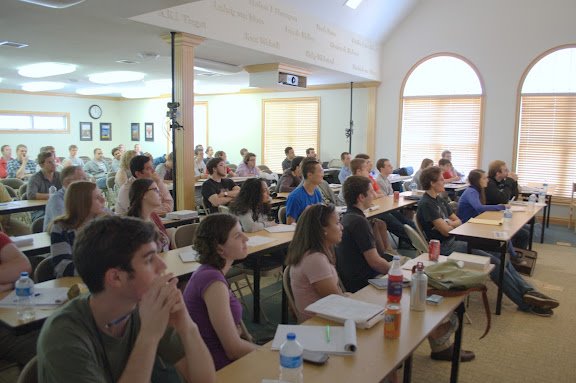
After returning home, Joan and I prepared for the conference. Then, we drove to the venue. Walking through the Silver Legacy Casino en route to the conference room was an interesting experience. Chesterton would probably get such a kick out of conferences being held in his honour in Reno, of all places! Joan and I arrived to the conference with plenty of time to register and browse the various tables that were set up to feature various organizations, initiatives, and books for sale.

I approached one very eye-catching display for Titanic Heroes. “Tell me about your display,” I said to the young woman waiting to greet passers by arriving early to the conference. An impressive young woman named Cady explained that she and her brother Benjamin had taken an interest in studying the Titanic. “Here is my new book,” said fifteen year old Cady holding up a copy of her just-published book A Titanic Hero: Thomas Byles. It’s the story of “One man…one ship…one night that was to be remembered forever. Thomas Byles, a Roman Catholic priest on board the R.M.S. Titanic, had the saying, ‘Give what you have,’ instilled into him from a very young age. His training, commitment, and love for others culminated into one shining example of fortitude in the face of danger. This book, historical fiction, narrates the life of Thomas Byles.”

Cady and Benjamin and the other three Crosby siblings are a shining example of homeschooled children. Since they are homeschooled, they have plenty of time to participate in speech and debate, publish books, and to “cultivate titanic virtue” by sharing the stories of Titanic heroes through their presentations across America.

The conference kicked off with an introductory lecture by Dale Ahlquist, the president of the American Chesterton Society. He encouraged attendees at the Reno conference to “put their money on the Chesterton table” and to support the Society by buying Chesterton books and even the “CHE-STERTON” t-shirt. The Chesterton Society has plenty of quirky rituals and this is exactly what a good society requires. From allowing whoever experiences the greatest series of unfortunate events throughout the conference to drink from the “cup of inconvenience” and then be awarded the “mug of consolation” to having an annual clerihew contest where the prize-winning four-line biographical poems are recited and celebrated at the final banquet.

There are bracelets that say WWJD? which stands for What Would Jesus Do?
Perhaps we ought to have bracelets that say WHJD? for What Has Jesus Done? – Pearce

Next, Joseph Pearce delivered a lecture titled, “The Humor and Humility of Chesterton.” Pearce’s message celebrated tradition and repudiated what he terms “DWEM-ism”, which represents the contempt held by progressives for “Dead, White, European, Males.” Joseph Pearce asks, “Can a person help that they are dead? Can a person help that they are white? Can a person help that they are European? Can a person help that they are male?” Of course not. Hating tradition is like racism. This is Pearce’s message and it is a very sincere one. It comes from a man who was formerly aligned with a white nationalist party in England before his conversion. Pearce’s conversion from racism to Catholicism was greatly motivated by his reading of Chesterton. Pearce is now a tremendous apologist for the faith, an excellent biographer, and active in promoting homeschool education, the great books, and liberal education.

The following day, there were many excellent lectures given by: Cameron Moore, PhD at Baylor University; Ralph Wood, Professor of Theology and Literature at Baylor University; Jason Jones, President and Founder of Whole Life America and Producer of the film Bella; Mark Shea, Author and Master of Blogosphere; and Kevin O’Brien, President and Artistic Director of Theater of the Word Inc. Needless to say, the conference far exceeded any expectations that I had. The lectures were top-notch and paid good tribute to Chesterton. Key themes of the lectures included: transcendence and mystery, wisdom and humility, the goodness of existence, paradoxical truth and conversion, and wonder and awe.

My favorite speaker was Jason Jones who delivered one of the most extraordinary speeches I have ever heard. He began by joking that he is a Chesterton fan “more like a twelve-year-old girl feels about Justin Beiber.” For Jones, reading Chesterton also played a significant role in his conversion to Roman Catholicism. Jason was raised a scientologist, but rejected scientology in eighth grade and became “a hardcore Randian objectivist” until his early thirties. Jason grew up in south-side Chicago, surrounded by anti-Catholic bias.

I knew that Jason Jones had helped to produce Bella, a pro-life film released in 2006. Jones said to us, “As of today, 581 women who were going to have abortions saw Bella, changed their minds, and let us know.”

He said that receiving text messages informing him that another woman has chosen life for her child is the very best part of his job. All of these details become even more beautiful in light of Jason’s conversion story.

Jason was sixteen. It was two days before his seventeenth birthday and a Saturday morning after a Friday night high school football game. His girlfriend came into his bedroom, “the room of a boy” and informed him that she was pregnant. “There I was with my girlfriend and we needed a strategy,” recalls Jason. The plan we came up with was this: On my seventeenth birthday, I could drop out of school and join the army. She would wait for me to come back.”  His parents were supportive and the principal was happy to sign the papers. And so that’s what Jason did. He piled his belongings into a pillow case, along with a razor that he didn’t yet need and went to join the army so that he could support his family upon his return.

One day, a call came in and Jason took the phone, though he knew he wasn’t meant to leave his station. His girlfriend was on the phone and she was crying, “like I’ve never heard a woman cry before. And the only way that I can describe it is that her soul was crying. She kept saying, ‘I’m sorry, I’m sorry, I’m sorry.” Then, her father picked up the phone and said, “Jason, I know your secret and your secret is gone. I took Katie to get an abortion.”

Just then, someone came and hung up the phone and told Jason to get back to task. Jason, angry and shaken, said, “Sir, call the police. My girlfriend’s father just killed my child.” In reply the man said to Jason, “Why would I call the police? Don’t you know that abortion is legal?”

Jason did not know.

Jason was a poor student, but he says that he knew then that life began at fertilization. He was heart-broken. When he had the opportunity to phone his girlfriend back, he said to her, “Katie, I promise you that, even if no one cares about abortion and if it takes me the rest of my life, I will end abortion for you and our daughter Jessica.”

Jason and Katie know that the abortion ended the life of their daughter because when the abortion was done, the abortionist then said to Katie, “By the way, your baby was a baby girl.”

With Dale Ahlquist and Jason Jones, holding an autographed copy of Chesterton’s book on Rome.

Since this experience, Jason truly has dedicated his life to striving to end abortion and to help create a culture of life and build a civilization of love. He converted to the Catholic faith and now has six children. He is producing more life-affirming films, directing the organization I Am Whole Life, and travelling the world advancing respect for the sanctity of all human life from the moment of fertilization until the moment of natural death.

Conversion stories are awesome. They make the most beautiful stories because they bear witness so wonderfully to the path of salvation history consisting in passion (suffering), death (dying to self), and resurrection (new life in Christ).

On Friday evening at the Chesterton conference, there was the world premiere of the film Manalive, based on Chesterton’s novel by the same title. Manalive is the story of Innocent Smith, a character who is tried for such crimes as burglary, desertion of a spouse, polygamy, and attempted murder. If I may excerpt from Wikipedia, here is a summary of the wonderous Chestertonian paradoxes in the film:

“[Innocent Smith] fires bullets near people to make them value life; the house he breaks into is his own; he travels around the world only to return with renewed appreciation for his house and family; and the women he absconded with are actually his wife Mary, posing as a spinster under different aliases so they may repeatedly re-enact their courtship.”

After watching the film, I thought: I am a “cradle Catholic” yet I think I ought to convert to Roman Catholicism. I imagined myself taking Rite of Christian Initiation for Adult (RCIA) classes. Of course, life is a continuous experience of conversion, of return to God. Chesterton’s wit and wisdom adds wonder to the experience and reminds each reader that he is also “the man who with the upmost daring discovered what had been discovered before.”

On Saturday the conference sessions included a lecture by Nancy Brown on The Plays and Poetry of Frances Chesterton, a session by Julian Ahlquist on Chesterton and Aliens, a small group discussion on the economic ideas of distributism, and finally a closing lecture by Dr. Andrew Tadie contrasting Chesterton and H.G. Wells.

There was 5:00pm mass on Saturday evening celebrated at St. Thomas Aquinas Cathedral with the Most Reverend Randolph Calvo, Bishop of Reno.

Then, everyone returned to the casino to a ballroom where the closing banquet was held. There were jokes, toasts, songs, drama and musical performances, clerihew readings, a live auction (a signed Chesterton book was the top prize), plenty of wine, and lots of other fun.

The conversations that evening at my table centred around the presidential election, Austrian economics versus distributism, summer travels, music, Anglicanism, Presbyterianism, Catholicism, and our favorite Chestertonian aphorisms. It was an absolute delight to dine with young people who light up while discussing Chesterton because of how instrumental he has been in helping them to see more colourfully. Chesterton helps souls become poetic optimists. Chesterton writes:

“The optimist’s pleasure was prosaic, for it dwelt on the naturalness of everything; the Christian pleasure was poetic, for it dwelt on the unnaturalness of everything in light of the supernatural.”

I look forward to reading more works by Chesterton.
To everyone, I recommend his book Orthodoxy.

G.K. Chesterton, pray for us.

This blog post is dedicated to Joan and Michael Cassity in gratitude to them for having hosted me in their home and for having shared many wonderful conversations during the 31st Annual G.K. Chesterton Conference in Reno, Nevada. God bless you!

Tu ne cede malis: Reflections on Mises University

This past week I attended Mises University, a weeklong summer university in economic science. The sessions covered theoretical and applied economics, including epistemology and methodology, pricing, entrepreneurship, comparative economic systems, welfare economics, law and economics, industrial organization, environmental economics, money and banking, political economy, and the history of economic ideas. Hosted since 1986 by the Ludwig von Mises Institute, Mises University brings together knowledgeable professors and keen students for a week of immersion in the Austrian School of Economics.

I became interested in the Austrian School after attending an Institute for Humane Studies summer seminar last year during which I volunteered to read Leonard Read’s essay “I, Pencil” aloud during an opening session. That week, I also read F.A. Hayek’s essay “The Use of Knowledge in Society“. What was impressed upon my economic views through reading these introductory texts was akin to the influence that reading Plato’s Apology and the Simile of the Cave had on my elementary philosophical views. In both cases, the central message is that there is a need for humility that stems from the recognition of the limits of human knowledge.

When confronted with the recognition of his own ignorance, Socrates could have resented the limitations and stopped philosophizing or tried to philosophize beyond his scope of ability, to transcend the limits. But he did not stop and instead realized that insofar as “whatever I do not know, I do not even suppose I know”, he had grasped the beginning of wisdom.

What attracted me to Austrian School Economics is its a priorism, that is to say, its beginning with deductive first principles, the most fundamental of which is the action axiom. We begin with a true premise: humans act. Any attempt to refute this axiom would be a contradiction because refutation is an act. I became intrigued with Mises’s magnus opus Human Action, of which I have only read excerpts. Still, what led me to Mises University is the idea of economics not as a “dismal science”, as Thomas Carlyle termed it, but rather a science of human action, and thus a humane discipline intersecting with and relevant to the various liberal arts.
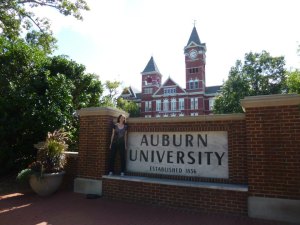
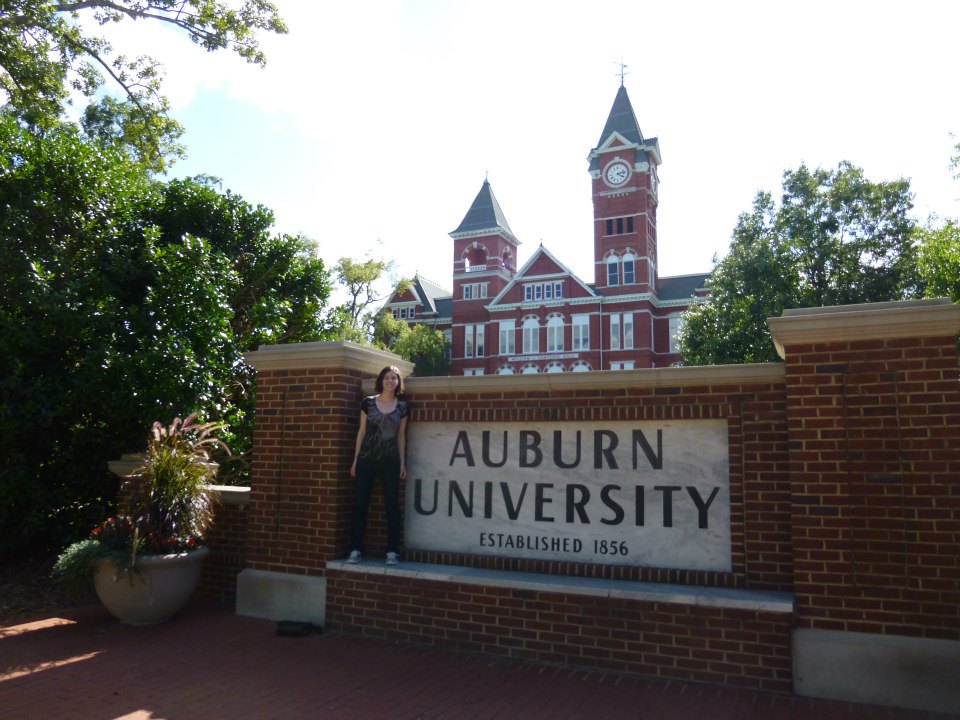
My first night in Auburn I had a dream about a random shooting on a train. It was obviously a result of my recent transportation combined with all the news about the shooting in Aurora, Colorado. From the Greyhound terminal, I had shared a cab with a student to the campus. The student and the cab driver discussed other shootings in recent memory and the cab driver kept repeating, “And to think, this guy in Colorado was going for his PhD.”

Using the Catholic mass app on my iPhone, I walked two miles and found St. Michael the Archangel Church where I attended Sunday mass. To be each week at once in a different church and in the same Church is an awesome thing. It’s also very comforting to find a Catholic church in a new city. It’s like finding a Starbucks. Every Catholic church contains the Blessed Sacrament and every Starbucks has complimentary wifi. So when I ritualistically genuflect in church and order a caramel macchiato at a Starbucks, I never feel too far from home.

As I walked through the streets of Auburn, I noticed so much football paraphernalia. Everywhere I went I saw Tigers-themed merchandise. As I peered in a window, someone stopped to say to me, “Football is a religion here.” Every day of Mises University I passed the football stadium, which has a capacity for 87, 451 people.

Traveling across the United States, I find that it is more common here for students to wear clothing with the names of their colleges or college football teams on them. Students here seem to derive a greater sense of identity from their colleges than Canadian students. It is not uncommon to ask a student where he or she is from and to receive the name of a college rather than a hometown or state. As for me, my inclination is to first call myself a Western Canadian, then to say I am an Albertan. When this is meaningless to them, I specify that I am from the “Texas of North.”

After mass, I went to Waffle House. It was packed. There I met a Chinese student named Sonya who is studying environmental engineering at Auburn. We decided to share a table when one became available and enjoyed one another’s company over brunch. She told me many interesting things about China. Her father works in the civil service granting fishing licenses and her mother is a retired banker. I told her that she is brave to leave her country for her first time to study in America, especially since she is not even returning home for a visit. I asked if she is an only child and she said, “Of course. And every one of my friends is an only child.” Sonya is from Shanghai. I didn’t resist asking her views on the one child policy, which she said she considers understandable given the population of Shanghai. I found this particularly bizarre given that not a minute later she asked me what I thought about animal testing in scientific experiments. She had been shocked to learn of students killing mice in pharmecutical experiments. I cringed when we discussed manipulating human populations, but not mice populations.

Then, we discussed education. She said that there is a lot of pressure in China because there is one exam that students take to determine what university career they will pursue. “The government determines you program of studies based on your score. If you don’t do well on it, you have to wait a full year to take it again,” explained Sonya. She continued, “The reason that Chinese parents often send their child to the United States is not because they have money, but so that their son or daughter can study whatever he or she wants.”

As we were paying our bills at Waffle House, Sonya asked if I had ever heard of the Tiananmen Square Protests. “Yes, I studied that,” I told her. Sonya said, “Well, my parents never told me about it and I never learned about it in school. I learned about the events at Tiananmen Square from Wikipedia two days after coming to the United States. If you search the Internet in China, the Web will only yield pages that say there is no information relevant to your search.”

After saying goodbye to Sonya, I returned back to the Cambridge dormitories at the University of Auburn. Soon after, my roommate Lorraine arrived. She and I decided to go for a walk. Lorraine studies German and History. I was impressed that she too had decided to come to a weeklong intensive seminar on economics, a field outside of her own program of studies. While my summer may seem extraordinary, it is not particularly exceptional relative to the summer adventures of many of the other students I am meeting along the way. It is not uncommon for me to meet people who have attended half a dozen conferences, travelled across the world, studied multiple foreign languages, and who are dedicated, well-rounded, and ambitious people. They inspire me tremendously by raising the standard of excellence.

The first night of Mises University kicked off with a lecture by Dr. Robert Higgs titled “Warfare, Welfare, and the State.” Employing lots of religious metaphors to criticize the state, he said at one point, “Even a shepherd keeps his sheep only so that he can shear and kill them.” This was quite a different use of the sheep metaphor than what I had heard in mass that morning. The psalm had been Psalm 23, “The Lord is my shepherd; I shall not want. He maketh me to lie down in green pastures: he leadeth me beside the still waters. […] thy rod and thy staff they comfort me.” Needless to say, I was very struck by how I had heard a similar metaphor to symbolize two very different points in the very same day.
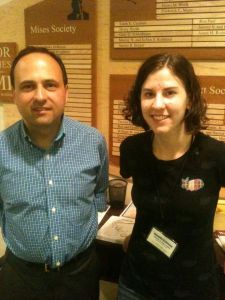
After this talk, I approached Dr. Tom Woods and mentioned what I described above. He told be he had been to mass in the Traditional Rite and so had not thought of it. I asked him what he thinks of Murray Rothbard and how he reconciles Rothbardian views on such things as children and rights with his Catholic faith. Woods told me that he had met Rothbard and said that Rothbard was changing his positions later in life, becoming more conservative, and that he even considered joining the Catholic Church. Woods insisted that one should not “throw the baby out with the bath water” when it comes to thinkers who hold inconsistent or even highly objectionable views.

The following evening Woods gave a lecture during which he said it was his aim to “inoculate [us] against the cult of anti-Rothbard.” As when a priest gives a homily that resonates in such a way that you feel it was written for you, this talk was an important wake-up call. Though he was addressing a broader factionalism within the libertarian movement, for me Woods was warning against being hastily dismissive of thinkers whose ideas I have not studied in depth or whose ideas I have not given the respectful consideration they deserve. Although, I still believe that you can learn a lot about a thinker by what he or she says about “the least of [our] brothers and sisters.”

On Monday morning Dr. Joseph Salerno gave an excellent lecture on “The Birth of the Austrian School”. He explained that there were two dominant theories in classical economics: cost determined by production and cost determined by scarcity. The key problem with these theories is that they failed to account for human want. Carl Menger, the father of the Austrian school, contested the cost-of-production theories of value and pioneered the theory of marginal utility and economic analysis centred around the idea that value truly lies in ability to satisfy for human wants. Dr. Salerno pointed out that when we say about a person, even a small child: “he knows what he wants” or “she knows what she wants”, we have a budding entrepreneur. Good entrepreneurship is the ability to successfully predict future wants and often develops from an individual considering his or her own wants and extending those to others and to the future.

The next lecture was delivered by Dr. David Gordon. He explained that Mises thought that economics could contribute to the field of epistemology. People are purposive. Every actor uses means to achieve ends. Gordon told us that Mises defined action as involving “felt dissastifcation.” You act because you want to change things for the better. All actions involve choice.

After this lecture, I had lunch with a student named Darren who just completed his bachelors degree in the United Kingdom. And it so happens that he wrote his undergraduate dissertation on praxeology, relying primarily on the work of Ludwig von Mises and other Austrians. Over lunch we aimed to distinguish between actions and instincts, correlating means and ends with purposive action and causes and effects with instincts and teleology in nature. We discussed whether nature is causal or purposive and whether rationality is implicit in human action. We also confronted the challenge of discerning the point at which a person begins to act.
Other lectures throughout the day were on the topics of: subjective value and market prices, the division of labour and social order, and Austrian capital theory. During the afternoon I overheard David Gordon recommending an Eric Voegelin book to a student. Afterward, I asked him about it and he began to tell me stories about Voegelin, whom he knew personally. I enjoyed listening to him and when he asked how I had heard of Voegelin, I told him that I have taken classes with Barry Cooper, whose name he recognized, although he has not met him. Voegelin keeps coming up throughout my travels this summer, enticing me to immanetize my reading of his six-volume Order and History.

I began to wonder whether Voegelin had a connection to the Austrian school of economics. A quick search led me to a Voegelin View article that discusses Voegelin’s
relationship with the Austrian School. Voegelin was invited to seminars hosted by Mises that he attended with F.A. Hayek and other students. Voegelin would have been about nineteen years old.

It struck me that, while Voegelin took an interest in the economic ideas within the developing Austrian School tradition, he found the focus to be somewhat narrow. Austrian Economics was not accounting for complexities factoring into the realities of human action that Voegelin considered essential to understanding the political order.

In a letter to Hayek, Voegelin wrote:

I think that I can agree with you on almost everything you have said. There is however one point where I should suggest a certain qualification of your argument. I do not believe that the problem is one of the economic system and state intervention exclusively, but I am afraid that the evolution of the religious state of mind towards collectivism not as an effect but as a cause of economic evolution plays important role in the structure of modern civilization. – Eric Voegelin to Friedrich A. von Hayek, April 14, 1938

Voegelin confirmed his position saying: 

I read your article The Intellectuals and Socialism. Reading it I had the same impression that I had when I examined Road to Serfdom. We are approximately concerned about the same problems and we are dissatisfied by the same grievances. As I see it, we differ on the interpretative issue. You understand the difficulties of socialists intellectuals observing the economic contrasts and maybe ethical between socialism and liberalism. For me, this contrast does not approach the issue deeply enough. You know my prospective from our discussion and from my lectures. I think that it is impossible to deal with the contemporary problems of intellectuals without taking into consideration the religious scenario, the “Gnostik” problematic. I have the impression that you come closer to this problematic in your work Counter Revolution of Science than in your economic interpretations? – Eric Voegelin to Friedrich A. von Hayek, February 5, 1951

As mentioned above, it struck me that Voegelin took such an interest in economic ideas but found them to be lacking important dimensions. It also struck me that Voegelin stayed in touch with his friends from Mises’s seminars. As I attend seminars hosted by the Mises Institute and read books by Voegelin and visit with people who knew him, I am starting to see more and more what it means for there to be a tradition of scholarship and how much politics and political philosophy has to do with friendship.

I recall a conversation I had during a meal with my friend Ross who I had met at a Liberty Fund seminar. Ross said, “I am tired of discussions where man is considered solely as human capital. I am a man!” he declared light-heartedly, yet sincerely and pounding his fist theatrically on the table.

And so I would sneak up to the Massey Library at the Mises Institute to read excerpts from Voegelin’s Order and History. A few paragraphs was a sufficient dose to enrich the Mises sessions with a broader perspective rooted in philosophical anthropology. I read the line: “Government is an essay in world creation.” Throughout the week I reflected on this single line the most. I found myself again asking: In what way are we made in God’s image and reflecting on the human experience of tension between being co-creators and sub-creators.

When I read this, I remembered what Cooper says about essays:

“An essay, as I understand it, tries to push an argument to its limit, with a minimum of qualification or second thoughts, and in a mood of considerable speculative confidence. An essay presents a perspective rather than new information. Much of the argument is, therefore, allusive.” – Barry Cooper, The Restoration of Political Science and the Crisis of Modernity

Spending the week with anarchists who consider government both unnecessary and evil, I reflected on the extent to which government is an attempt to imitate the divine ordering of the cosmos. It’s a poor imitation, counterfeit even, but it strives toward a resemblance. What we see in governments is plenty of ‘speculative confidence’ without the restraint that should follow from a recognition of limits.

Samuel Gregg writes:

The Catholic vision of the state underscores the legitimacy and limits of government authority. From the standpoint of Catholic doctrine, the authority of governments is derived from the divine and natural law. But the same state is subject to the demands of revealed and natural truth: the state is neither the source of truth nor is it above the truth.

On Tuesday, Walter Block offered a lecture titled “An Austrian Critique of Mainstream Economics”. Block is a well-known Austrian scholar and anarcho-capitalist. He worked at the Fraser Institute in Canada for many years. He follows Rothbard in many respects, but differs from him in some important ways too. Block describes himself as a devout atheist. He began his lecture with an overview of praxeology saying, “We don’t test things; we illustrate them.” Block was “converted” to libertarianism after attending a lecture by Ayn Rand and to anarcho-capitalism after attending a lecture by Murray Rothbard. Since many thinkers count meetings with key thinkers in their day among the most influential moments of their intellectual and personal development, I made sure I had a few conversations with professors one-on-one or with a couple of other students.
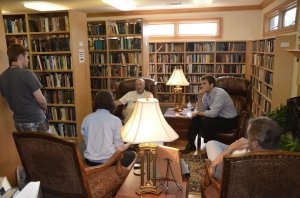
One afternoon I had a conversation with Block. We discussed Catholicism, libertarianism, the divine right of kings, self-ownership, abortion, and ordered liberty. Discussing ordered liberty, Block asked the question that he is known for asking and that seems to be the primary measure of his judgment: “Are they real libertarians?” He had asked this to me after I had told him about the Acton Institute. “What are they adding to liberty with this order business?” he asked skeptically. I explained that they are interested in promoting a free society and also discerning how to live out that freedom in accordance with truth.
“But what if I don’t want truth? I like falsehood. Two plus two is five,” challenged Block.
(Do you ever find it interesting how everyone seeking to rebel against this particular equation always comes up with the answer five? Not three. Not six. Or any other number. They are conformists in their attempts at rebellion.)

Block had stately clearly that libertarianism is not a philosophy of life. All that it tells you is to avoid harming others. It doesn’t tell you that Mozart’s music is beautiful. But why not harm others? I asked. He tried to argue that harming someone would involve a practical contradiction based on Hans Hoppe’s argumentation ethics. This is the same argument used for self-ownership. But to disagree with the harm principle does not by itself involve doing any harm to someone. And disagreeing with the concept of self-ownership does render argumentation impossible.

I greatly enjoyed my conversations with the professors throughout the week. However, I did not find myself converted by any of the economists. Unlike those who went from persecuting capitalists like Saul persecuted Christians, I must say I have had no similarly dramatic Road to Damascus conversion along the Road to Serfdom.

It was not an uncommon question throughout the week by fellow attendees whether I was a “cradle free-marketer” or whether I came to the ideas after reading Atlas Strugged or watching Ron Paul videos. I reflected on my parents’ example. They are both entrepreneurs. They have worked from home my entire life. My dad worked in oil and gas before inventing a product. My mother has always been spontaneous and creative. I reflect on her taking me to garage sales a lot when I was young and encouraging me to barter. I recall having garage sales and selling lemonade and cookies. I also recall making my first “investment” at age 11 in a babysitting certificate program with a small loan that I would pay back to my mom with the income from my first couple of jobs. In my early teens, I had photographic business cards that I would give to parents after playing with their children at the park to drum up babysitting business. I recalled fundraising hundreds of dollars for the Terry Fox Run annually and going throughout my neighbourhood asking for donations after rehearsing my fundraising pitch with my dad.  Throughout my whole life, my parents have been modelling entrepreneurship and encouraging creativity.

Hearing so many socialist conversion stories had me counting my blessings. Working at the James Joyce Irish Pub led me to observe and reflect on what it takes to run a small business. I learned about how Anne and Gerard took a lot of risk, but had a clear goal to start the pub. Knowing their story and learning from how they ran their business meant that my part-time job was a lot more meaningful than I may have realized at the time.

My experiences at Mises University were also a cause for reflection on what it meant to grow up in Calgary, Alberta. While among anarchists who resent patriotism and think all borders unnecessary and imaginary, I still could not help but realize that I am who I am because of the particular environment in which I grew up and now live.

I found myself wanting to defend Canada, especially when the speakers would say that the Canadians have “some explaining to do” for all our socialism. We are more economically free than the United States now, I would say referring to Canada recently surpassing America in an Economic Freedom Index. Then, I would boast about Canadian federalism. How does the supposed power of the states in the U.S. compare to the provincial jurisdiction of healthcare and education in Canada now? I thought to myself: I’m not particularly patriotic, but suppose that I wanted to take some pride in my country. What is there of which I can or should be proud?

Some of the best parts of Mises University were the conversations that I had with fellow students outside of the intense periods of scheduled lectures. One evening I had several particularly good conversations about Catholicism. (I am meeting so many young converts!)  With a small group I discussed Plato, Aristotle, Augustine, Aquinas, Machiavelli, Rousseau, Hobbes, Dostoyevsky, Tocqueville, Nietzsche, Burke, Mises, Fulton Sheen, Russell Kirk, Leo Strauss, and others over the course of the evening.

One young man with whom I spoke and who is converting to Catholicism from being a Baptist told the group that he has read Augustine’s City of God in its entirety and recommended it strongly to all of us. Another student who I met studies at Harvard and told me about his classes with Dr. Harvey Mansfield. “We spent fifteen minutes discussing the first words of the Republic,” he said. I smiled remembering that I too had had similar experiences being guided through the opening lines of Plato’s Gorgias (“War and Battle”) and of Plato’s Republic (“I went down”). My late-night conversations with these dedicated students was such a gift. I count myself blessed to have been in their company.

On the final day of Mises University we had a barbecue dinner at the Institute. Everyone was outside, laughing, telling jokes, eating burgers and coleslaw and cookies. Several of the professors’ families, including many young children, had arrived for this final dinner. It was good to see. As everyone gathered around for the closing ceremonies, I cherished the experience. For a bunch of individualists, it seemed we hadn’t done too bad a job at being a community.

This blog is dedicated in gratitude to James Forward who sponsored my attendance at Mises University. 

What do we seek to conserve?

“But nature gave the word ‘glory’ a meaning for me.” – C.S. Lewis, The Four Loves

After a short flight from Pennsylvania to Alabama, I arrived to the Birmingham airport. There I was greeted by Chris, a program officer at the Intercollegiate Studies Institute (ISI). We drove to the Samford university campus where the First Principles of Freedom Summer School for the Thoughtful Conservative was to be held. Since I arrived early, I seized the opportunity to complete the assigned readings for the seminar. It was exciting when all of the other participants began to arrive to Samford though because then I got to listen to their Southern accents.At registration, ISI gave us about a dozen books, hard copies of the texts that we had been reading in PDF formats and few additional texts pertaining to the American founding, conservatism, and liberal education.It was during this warm reception that I first met Dr. Rich Brake, the National Director of Education for the Intercollegiate Studies Institute.

Then I returned to the dormitory to meet my fellow participants.Most of the students at this conference are from the South and I was the only foreigner. My new friends gave me an immediate taste for the spirit of the South. My roommate Taylor and her friend Mary belong to the same sorority and they asked me if “Greek Life” is a part of Canadian university culture. Not really, I said. “Well, if you are not Greek in the South,” they explained, “then you practically have no life.” Mary said, “I joined for political reasons.” They informed me that they both spend about $3500 annually for membership in their sorority, which they explained is the most well-reputed sorority on campus and the one whose students have had top grades for twenty years. I was shocked that sorority dues were that expensive, but Taylor and Mary said that this is their only expense at university since they have been awarded scholarships. They said that approximately 25% of the university population belongs to a sorority or fraternity and that these are the only people who have any authentic social life on campus. “It’s more than good parties,” they insisted. “It’s about reputation, grades, opportunities, scholarships, and even future political connections.” All of this fascinated me. “Furthermore,” they said, “the sororities and fraternities are completely racially segregated and that’s the way everyone wants them to be.” Seeking a point of reference, I asked: “So, it’s like Mean Girls?” referring to the 2004 film. “Pretty much,” agreed Taylor and Mary, “Except we’re not mean.” All of this I learned in my first ten minutes with Southerners.

“And if anyone asks me what I think the chief cause of the extraordinary prosperity and growing power of this nation, I should answer that it is due to the superiority of their women.” – Alexis de Tocqueville, Democracy in America

As we got ready for the evening activities, I was mildly intimidated by both the candor and poise of the young women, but thankfully I was here to attend a conference and not to be “rushed” before a panel of punctilious judges.In the evening, Dr. Brake gave a lecture “On the Conservative Intellectual Movement in America.” To begin, he posed several
questions: What does it mean to be a conservative? What kind of culture are the Americans seeking to conserve? What does conservatism have to do with the acceptance constraints and limits? Does reverence for the Constitution mean that American conservatives are paradoxically seeking to conserve a revolutionary act? Dr. Brake spoke about prudence, custom, and tradition; he spoke about Jerusalem, Athens, Rome, and London coming together in Philadelphia; and he spoke about the three main factions of conservatism that he considers to include: traditionalists, libertarians, and anti-communists. For several decades, anti-communism was the glue that bound traditionalists and libertarians together. Will the conservative factions be united to counter the ‘soft despotism’ of which Tocqueville speaks and the ‘road to serfdom’ of which Hayek speaks? Dr. Brake then emphasized what conservatism is not. He said, “It is not an ideology, it is not a cult of personality, it is not relativistic, it is not utopian, and it is not centralized. After all, he explained, a conservative is simply someone who sees the glass 10% full.”

“For God, For Learning, Forever” Motto of Samford University

Speaking of glasses, ours were always filled with lemonade since Samford is a Baptist university and a dry campus. The environment made me recall the phrase ‘Bootleggers and Baptists’ which refers to “opposite issue positions lead[ing] to the same vote. Specifically, the criminal bootlegger favor prohibition because decreased supply generally equals a higher profit margin for the criminal bootlegger. The preacher favors prohibition, citing religious reasons. Both the criminal bootlegger and the preacher vote in support of prohibition.” I had been vaguely familiar with historical temperance movements and the issues surrounding prohibition. Being on a Baptist campus brought this history to life to the extent that I felt I was grasping the political and religious culture through some participation in it.In the morning, I awoke to the sounds of bells tolling. I realized how much I love waking up to the sound of bells. Better than any ring tone or alarm, bells inspire me to wake up quickly. Every time I heard the bells ringing I felt as though I was being summoned to some purpose. And whenever I heard the bells ringing, it was as though dignity was being added to the day.

The first lecture on day one was by Dr. Scott Beaulier, a professor of Economics at Troy University. He spoke on F.A. Hayek’s The Road to Serfdom. After each session, we had a question and answer period with the professor. The second morning lecture was by Dr. Art Caden, professor of Economics at Samford University on Adam Smith’s Inquiry into the Nature and Causes of the Wealth of Nations. Both sessions were excellent. In the afternoon, we discussed the sessions and the texts in small groups. During the session on Hayek, I raised question about Walter E. Williams’ forward to Hayek in which he discusses the need to make “unassailable arguments for personal liberty” and says “Any part of the socialist agenda can be shown as immoral under the assumption that people own themselves.” I asked about whether or not Hayek shared Williams’ conception of self-ownership as the basis for property rights and free markets. I also suggested that many conservatives would contest self-ownership (at least in the way the idea is being advanced now) and that these people are conservatives, not socialists. Are our lives an extension of our right to property? Or, are our rights to property an extension of the rights that we have first in virtue of our existence?

When discussing Adam Smith, we discussed the question of whether there is a necessary link between patriotism and protectionism. But the favorite excerpt that we read from Smith concerns his ideas on education. We could see that a lot of his ideas are relevant to contemporary education policy. Inspired by this session, my friend Alex and I made this short video during our free time one afternoon.

In the evening, we had a special guest lecture with Stephen Moore, member of the Wall Street Journal Editorial Board and Founder of the Club for Growth on “The Future of Economic Freedom.” He began his lecture by telling us that if we want to  be the smartest person in any room, we should read the Wall Street Journal daily. He also said that a study has shown a relationship between reading the Journal and increased income. During his lecture, I felt like I was at home in Alberta. He spoke about the Bakken region in North Dakota where there is currently a major oil boom. Job hunters are flooding the  region, cost of housing is sky-rocketing, and North Dakota is now the state with the lowest unemployment rate in America. He spoke to us about “fracking” and said, “To be against hydraulic fracturing is like being against a cure for cancer.”

From the little that I have studied on the topic recently, I find that the investors and financial advisers I read say that you should pay yourself first and the entrepreneurs and business owners I read say that when you’re an entrepreneur, you’re the last person to get paid. Both cases involve paying oneself. Most students are lacking advice from both investors and entrepreneurs and so they think not about paying themselves, but about receiving a regular paycheck or fixed salary. It is important to find good mentors who encourage entrepreneurship and investment and who point out the foolishness that “Liberals love jobs, but they hate employers”, as Stephen Moore said to us.

The following day, Dr. Donald Prudlo gave a lecture on Robert Nisbet’s The Quest for Community and Dr. Rich Brake gave a lecture on Alexis de Tocqueville’s Democracy in America. Dr. Prudlo’s lecture was excellent and reminded me of the lectures at Acton University. He encouraged us to think about the questions: What is an individual? What is a person? What is society? He reminded us of Edmund Burke’s quote: “Society is a partnership in all science, a partnership in all art, a partnership in every virtue and in all perfection. As the ends of such a partnership cannot be obtained in many generations, it becomes a partnership not only between those who are living, but between those who are living, those who are dead, and those who are to be born.”

I raised the question: How do we promote a culture of associations rather than allegiances? referring to a distinction that Nisbet draws. How do we cultivate virtues rather than the mediocrity that is fostered in a system of bureaucracy? Dr. Prudlo said, “We need to make people feel bad and let them fail sometimes.” It is important to celebrate virtues and successes and to recognize failure for what it is and to acknowledge that it exists.

We also discussed the idea of modernity beginning with William of Ockham (Richard Weaver holds this view) and the extent to which nominalism is the foundation of the modern project.

During our discussions on Tocqueville, we asked: What is the relationship between democracy and utilitarianism? Why did ancient democracy not tend to utilitarian morals? Someone quoted Thomas Jefferson who said, “The democracy will cease to exist when you take away from those who are willing to work and give to those who would not.”

We also discussed the extent to which democracy leads to homogeneity.
Tocqueville explains that when the majority is sovereign then many, of course, will want to join the majority to exercise to comprise that body which wields the sovereign power.

I recalled a story of when I was in high school on the Graduation Committee. I was conducting a survey to determine which song would be the preferred graduation song of the majority of students. One student asked which song had received the most votes, which song was the most popular. When I informed him that my telling him the answer would not be very productive to the survey, he said with resignation, “Add me to the majority.” I think this revealed something interesting about many people’s participation within a democracy.

Another evening we had guest lecture by Luther Strange, Attorney General of Alabama. He spoke on the lawsuit that he is helping to file against the Obama administration on the HHS mandate on the grounds that the mandate violates religious liberty. During the question and answer period, I asked a question about whether he thought that the religious liberty arguments could go too far and extend to allow acts that we now consider criminal. He said that such cases are cases for the courts, that they can exercise judgment on these particular cases. He himself said that he would rather consistently err on the side of religious liberty.

A definite highlight throughout the week included lunchtime conversations with faculty members and many of the interesting and engaged students. I was pleased to meet Dr. Brickey LeQuire who studied Social Thought at the University of Chicago and whose dissertation was titled “Political Theology in Eric Voegelin’s Philosophy of History”. My conversations with fellow students inspired me to greater dedication to my studies. I am so pleased to have met so many students who are passionate about ideas, and so much so that they devote a week during the summer to learn through reading, lectures, and discussion.

“The first principles of freedom are easier than the first principles of basketball, because the principles of freedom come from the heart. Basketball is a sport.” – Dr. Brake

On the last night of seminar we had a BBQ and played some basketball and kickball. It was a lot of fun. I am grateful to the Intercollegiate Studies Institute for all of the excellent work that they do to support students in studying and advancing liberty for the sake of truth.

Liberty, then what?

“May the intellectual winds occasioned by each conference carry you out onto the philosophical seas, upon which the shores of mediocrity cannot be seen on even the remotest of horizons.”
– my good friend Walter Reid

I begin composing this blog from the City Tavern in Philadelphia where I am drinking Thomas Jefferson’s 1774 Tavern Ale. According to the menu, Jefferson made beer twice a year and this ale is made following his original recipe. After ditching my backpacks at the Apple Hostel on Bank Street, I strolled through the historic streets for a while. The city has character; it’s not pristine, but it is established. Before coming here, if you had said “Pennsylvania” I would have thought of the Pennsylvania Avenue and Pennsylvania Railroad squares on the Monopoly board.* If you had said “Philadelphia” I would have thought of cream cheese and if you said Pittsburgh, I’d have said “Penguins.” Before I came here I didn’t know that Philadelphia was a temporary capital of the United States, that it was here that the Founding Fathers signed the Declaration of Independence, and that William Penn’s 1701 Charter of Privileges helped to create a bastion of religious liberty. The city of brotherly love was so named for its “Holy Experiment” that had many failures, but also various successes.  So, as I often say, I am traveling the United States this summer to get an American education without paying American tuition, and also to learn some American geography.

I mentioned Tocqueville in my previous post and indeed this thought continues to come to mind: Tocqueville came to America to study the prison system and ended up writing about American democracy, constitutionalism, and liberty. I came to America to study liberty and am ending up learning about welfare statism, the unconstitutional expansion of state jurisdiction, and coercion.

This past week I attended a summer seminar hosted by the Institute for Humane Studies at Bryn Mawr College. Accommodations, meals, tuition, and books are funded for students accepted to the seminars through the generosity of private donors. Throughout the week, we study the ideas of liberty through the various humane disciplines or liberal arts.

I chose to come this particular week because I knew that Dr. James Stacey Taylor would be here and I had met him last year. He is a professor of philosophy at The College of New Jersey. He is also notorious for pushing the boundaries in libertarian thought (Are there boundaries?), especially with his arguments for the commodification of human organs, votes, and parental rights. His biography notes that his book Stakes and Kidneys: Why markets in human organs are morally imperative led to him being branded a heretic in the London Times.

WTF do positive rights come from?

Prof. J.S.T. argues that if J.S. Mill’s “Harm Principle” guided public policy, then many actions that are presently illegal would become decriminalized. He introduces students to central ideas of the Scottish Enlightenment, especially Francis Hutcheson’s notion of “moral sense.” Additionally, Prof. J.S.T. encourages us to consider why positive rights are less important than negative rights (and might not even exist).

I mentioned to Dr. Taylor my interest in bioethics. Through conversation, he helped me to clarify my interest in philosophical anthropology over practical medical ethics. One of the best parts of Institute for Humane Studies seminars is the evening socials where debates rage on between professors and students, except they become much more interesting because there’s beer involved. So my friend Marc and I engaged in an intense philosophical chat with Dr. Taylor. He proposed numerous trolley cases. The first and most well known is this: There is a trolley about to hit five people. Would you switch it to another track if it meant killing one? I initially and consistently said, “No.” My answer is likely a combination of my study of Plato, Aquinas, Machiavelli, and Dostoyevsky.  I would not choose to destroy life for the sake of life. “But there’s more life,” said Dr. Taylor. The end does not justify the means. I am a Christian and not a utilitarian. One should not commit certain evil so that some possible good may come from it.

This is Marc.

Dr. Taylor is a utilitarian and he rigorously challenged my position. Eventually the hypothetical choice became between an anencephalic [meaning “no brain”] newborn and my new friend Marc, who was sitting across the table from me. I knew little about the particular condition of anencephaly, but resolved that I would not act. Essentially, Dr. Taylor was asking me the same question that Polus asked Socrates: “Would you rather suffer than do injustice?” Socrates replies, “I should not like either, but if I must choose between them, I would rather suffer than do [injustice].” The extension to allowing someone else to suffer rather than choosing calculatingly to commit injustice is simply an act in accordance with the commandment to “love your neighbor as yourself.”

C.S. Lewis says, “Miracles are a retelling in small letters of the very same story which is written across the whole world in letters too large for some of us to see.” I am interested in what miracles (or mysteries) tell us about the truth of what constitutes human life. A quick search online leads me to find examples of people living when nobody imagined it was possible. According to this article, Nicholas Coke, an anencephalic infant, is still alive at nearly four years old. Then, there is the incredible story of Chase Britton who was born without a cerebellum or pons – which control motor skills, emotions and sleeping and breathing. His mother Heather says, “’No one had ever seen it before. And then we’d go to the neurologists and they’d say, ‘that’s impossible, he has the MRI of a vegetable.’” Cases like these affirm my conviction that all human life is sacred not because of what we can accomplish, but because of what God can accomplish through us. These lives are changing the lives of those around them.

Dr. Taylor argued that he would call dolphins persons, but not fetuses on the basis of self-awareness as the fundamental criterion for personhood. Dr. Taylor raised many important questions that I intend to continue to explore including: What is a person? Why are persons more significant than other forms of life? Why do we have a moral responsibility to protect life?

I appreciated how he challenged me with the utilitarian argument that if you value life, then should you not value the choice in favor of saving more lives over fewer? “There would be so much more dignity and flourishing. It is multiplied,” he said. I could not agree. I was firmly opposed because life that is intrinsically valuable cannot be held up against other lives of the same intrinsic value. It reminded me of a line in Nietzsche’s Thus Spoke Zarathustra (which I am reading slowly): “True, we love life, not because we are used to living but because we are used to loving.” It is as though the utilitarians are saying: True, life is valuable, not because we value life itself but because we live to value.

One of the most important things I learned in History 200 is to not consider a philosopher apart from his or her biographical and historical context. I had read Dr. Marco Navarro-Genie’s paper on J.S. Mill and Auguste Comte’s correspondence and considered myself mildly more equipped this year to critique Mill’s utilitarianism, positivism, and even millenarianism. I also had a powerful line from his Autobiography on which to dwell throughout the week. Mill wrote about the “crisis of [his] mental history” that occurred when he was twenty. He said:

“Suppose that all the objects in your life were realised; that all the changes in institutions and opinions which you are looking forward to, could be completely effected at this very instant: would this be a great joy and happiness to you?” And an irrepressible self-consciousness distinctly answered, ‘No!’ At this my heart sank within me: the whole foundation on which my life was constructed fell down. All my happiness was to have been found in the continual pursuit of this end. The end had ceased to charm, and how could there ever again be any interests in the means? I seemed to have nothing to live for.”

That sounds like downright Augustinian restlessness. I bit my tongue from asking Dr. Taylor, “What’s the most pleasurable thing on earth?” and changed the question to this: “If life is about maximizing pleasure and minimizing pain, then what is the height of pleasure and is pleasure really the best we can get?” To this he simply said that pleasure is good enough and that pleasure is “pretty darn good.” I wasn’t satisfied.  There are too many testimonies of pleasure failing to please.

Throughout the week, we had sessions on such themes as: spontaneous order, the harm principle, constitutionalism, rational ignorance, formal versus informal institutions, natural morality, libertarian class analysis, schools of economic thought, the Great Depression, the failure of foreign aid versus market-based development success, war, and property rights.
It was an intensely enriching week. I joked that the reason I choose to be a university student during the year is mainly to be eligible for these summer conferences. Of course, both university and summer education is wonderful. I like to, as the mottos go: “Vacation with a purpose” and “Think more, sleep less.”

We had a very interesting debate during the week on whether or not someone can alienate his or her liberty. I raised the point that J.S. Mill makes when he says, “The principle of freedom cannot require that he should be free not to be free. It is not freedom, to be allowed to alienate his freedom.” This issue is raised under the applications section of Mill’s “On Liberty” where he discusses suicide and voluntary slavery. Prof. J.S.T. disagrees with this point and says that voluntary slavery is perfectly morally acceptable because liberty is instrumentally valuable in enabling individuals to lead lives that they see fit and secure the goods that they prefer.  He said:

“Imagine this: Somebody is a devout Catholic and they decide to enter a monastery. They want to enter an order where every one of their actions is controlled by their abbot. They’re going to give up their liberty. They’re doing so freely and voluntarily; to secure a good that they believe is worth it: A regimented life in service of God. I think that people should be allowed to do that. And indeed, we do allow people to do this. […] I believe that liberty is extremely valuable, but it’s valuable instrumentally, as a means to securing the ability of persons to live their lives as they see fit.”

Cloistered Nuns. Voluntary Slaves?

I found this account very interesting and appreciated that he, one of the staunchest defenders of liberty I know, clarified his position that liberty is essentially instrumental, not an end-in-itself. In one session, Prof. J.S.T. discussed legal rights versus moral rights. He teasingly calls legal rights the Lego blocks of rights that we give to lawyers to play with. Moral rights are much more interesting and moral rights are the ones with which philosophers are concerned. At the end of the week, I thought: moral rights are fun, but moral truths are even more exciting. Once we have freedom from coercion and our actions have moral weight, what are the very best actions we can choose to be flourishing human persons fulfilling our freedom in truth? And then, I find myself returning to Aristotle’s Ethics and spiritual reading and gaining increasing enthusiasm for ordered liberty.

This year, I found more people at the seminar to be sympathetic to religious ideas, or at least a bit less hostile. I met some students from Latin America and asked if any of them are planning to attend World Youth Day next summer in Brazil. From there, I had a conversation with a young woman from Guatemala.

She asked, “Have you also been struggling to reconcile libertarianism with your Catholic faith? I thought I was the only one!” So we sat down on some steps and had a very good discussion. We were warned in our conference binders that: “Through all this learning and sharing, new ideas can create a sense of what some researchers call ‘disequilibrium.’” I asked my new friend, “What do you think of the young men at this conference? Do you find yourself asking: Would they make good husbands? Would they make good fathers? As soon as I started speaking like this, I could tell that what I was saying was resonating with her. It is unattractive when people confuse liberty for sheer license and this is the tendency that we had observed.

Also, she goes to Universidad Francisco Marroquin, a free-market, pro-liberty university in Guatemala. (Yes, in Guatemala. You read that correctly.) We discussed how it is practically a competition there, much like at this seminar, to be dogmatically libertarian. (For example, I was called a fascist for supporting laws against drunk driving and age of sexual consent laws. One of the sessions was titled: “Why Not Anarchy?”)

So she was curious about my views on libertarianism and faith. I shared with her some of my experiences. Last year I had attended my first Institute for Humane Studies seminar. I became quite enamored with libertarian ideas, especially since I found them fairly easy to learn and quite difficult to refute. I was beginning to think that freedom makes truth. On a World Youth Day pilgrimage this summer in Madrid, I began to reflect on John 8:32. It says: “And you will know the truth, and the truth will make you free.” I saw libertarianism as a reversal of this passage and thought about how I was confusing the means for the end. In the Gospels, the disciples are confused too: “”We are descendants of Abraham and have never been slaves to anyone. What do you mean by saying, ‘You will be made free?’” Jesus explains to them that they are slaves to their sin.

Throughout the week, many idealistic visions of a libertarian utopia completely free from coercion were envisioned. I thought about how a book might be written in the same vein as Thomas More’s Utopia with these ideas. Still, there would be human nature. Still, there would be pride. Still, we would not be able to redeem ourselves. Libertopia would not satisfy, nor could it possibly exist. Liberty is the indispensable condition for moral choice. That’s why I want to defend and advance it. But liberty exercised in a refusal to respond rightly to moral truth is misdirected and unfulfilling.

During some of the sessions at World Youth Day, I thought: Wow, I have never heard anything so beautiful, so good, and so true! I asked my friend: Did you ever find yourself thinking that the sessions throughout the week were pointing to something beautiful, good, and true? We concluded that, as much as we learned from the sessions and found them to provide a solid foundation, they did not point very far. She summed up the conversation best when she said, “We need transcendence.”

At the end of the week, Prof. J.S.T. gave another good explanation of the nature of liberty. He said that he considers liberty both “a means to” but also “a necessary part of” the ends which it is instrumental to securing. Oftentimes, a child will be drawing or painting a picture and not doing a very good job. He may sometimes realize that he will do a worse job than the adult supervising him. Still, the child will say, “I want to do it myself.” Dr. Taylor says he thinks that this behavior can give us important insight into human nature and he thinks this desire “to do it myself” is carried through beyond childhood. This reminds me of Aldous Huxley’s character Bernard Marx in Brave New World who says, “But I don’t want comfort. I want God, I want poetry, I want real danger, I want freedom, I want goodness, I want sin.”

The Institute for Humane Studies seminar was another enriching educational experience. I am grateful to the students, faculty, organizers, and donors for making it happen. I appreciated the opportunity to explore the philosophical foundations of free society and to question my assumptions. Dr. James Stacey Taylor was particularly helpful. He challenged me rigorously, welcomed me to conversations, and was respectful, patient, and kind.

At the very end of the week, I asked him if there is one thing that he advises that students bear in mind. To this he replied: “Remember that most people genuinely want to make the world better.” Since most people seem to attest to this by their lives, I am inclined to take it to heart and try to repair the world (Tikkun Olam), but not to redeem or recreate it.

*I have since learned that Pennsylvania Avenue is “America’s Main Street” actually located in Washington, D.C.