Unknown's avatar

About Amanda Achtman

What matters to me is living in truth, taking responsibility, creating value & cultivating community.

Thoughts on Dostoyevsky’s Crime and Punishment and Current Affairs Along with Some Reflections on Travel Experiences and Political Philosophy

I decided to read Crime and Punishment upon the encouragement of a former professor.  He and I had been discussing the Montreal student protests. This year, tens of thousands of students have been “on strike” in what has been called “the largest act of civil disobedience in Canadian history.” University students are protesting both the increase in their already extremely heavily state-subsidized tuition and Bill 78, a short-term emergency law that requires protests on or near university campuses to first be granted police approval.

Students consider themselves entitled to higher education and more students than ever are attending post-secondary institutions. It seems that the student status is a major source for their sense of self. A student’s identity is wound up in his or her affiliation to an institution of higher learning and to a program of studies.

Hungry for belonging and purpose, students live in relativistic times where commitments are made to trends rather than principles. They don’t know who their heroes are and cannot imagine something worth dying for. I recall hearing a speaker recently who said, “People who do not know what is worth living for will sell their lives cheaply.”
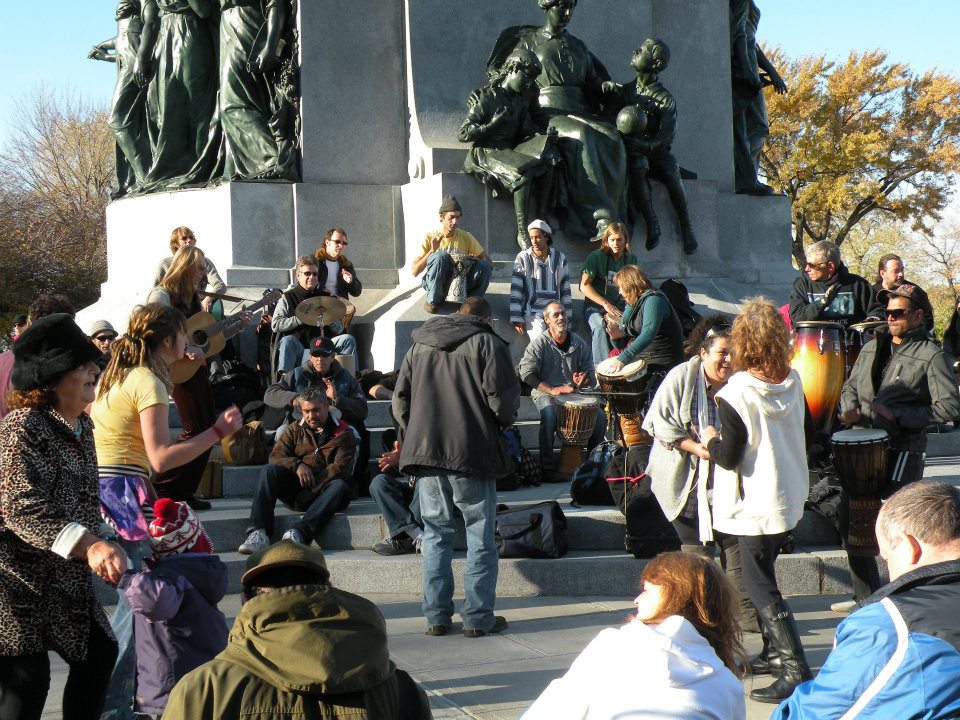
A much different scene in Québec compared to Alberta

So this professor of mine called my attention to Dostoyevsky’s character Raskolnikov, noting that the character consistently refers to himself throughout the book as a “former student.” And so I picked up a copy of the book while in Ottawa, the capital of Canada that borders the province of Québec. I had been across the bridge to the French province and seen the pubs brimming with “poor” students, all wearing red squares of fabric pinned to differing parts of clothing… a strange effort at diversity amid conformity.

I picked up the book and was captured by this sentence on the back cover: “In the slums of czarist St. Petersburg, Raskolnikov, a sensitive intellectual, is driven by poverty to believe that he is exempt from moral law.” Edmund Burke in Reflections on the Revolution in France lamented, “The age of chivalry is gone. That of sophisters, economists, and calculators, has succeeded; and the glory of Europe is extinguished forever.” Today, we may lament that it is the age of relativists, subjectivists, and utilitarians that is succeeding.

I read Crime and Punishment leisurely over the past month, not because it wasn’t gripping, but because it was a busy month. A part that really struck me is the scene where Raskolnikov is eavesdropping on a conversation between a young officer and a student in a restaurant. The student says:

“This old woman’s money, which is going to be sequestered in a monastery, could beget a hundred, a thousand good deeds and fresh starts! Hundreds, perhaps thousands of lives could be put on the right path, dozens of families rescued from poverty, from ruin, from collapse, from decay, from the venereal wards of the hospitals – all this with her money! Kill her, take her money, dedicate it to serving mankind, to the general welfare. Well, what do you think – isn’t this petty little crime effaced by thousands of good deeds? For one life, thousands of lives saved from ruin and collapse. One death and a hundred lives – there’s arithmetic for you!”

Evening Stroll in Gisenyi, a City that Borders the Congo, with Genocide Survivor and Our Rwandan Guide, Faustin.

In May, shortly before beginning the book, I was in Rwanda studying the genocide with fifteen Canadian students who have similarly utilitarian inclinations to those expressed by the student above. While in Rwanda, over dinner in Kigali, I asked my peers, “If you had to choose between saving a thousand animals or a single person, what would you do?” These students with whom I had been touring genocide memorial sites replied nearly unanimously, “It depends on the animal” and “It depends on the person.”
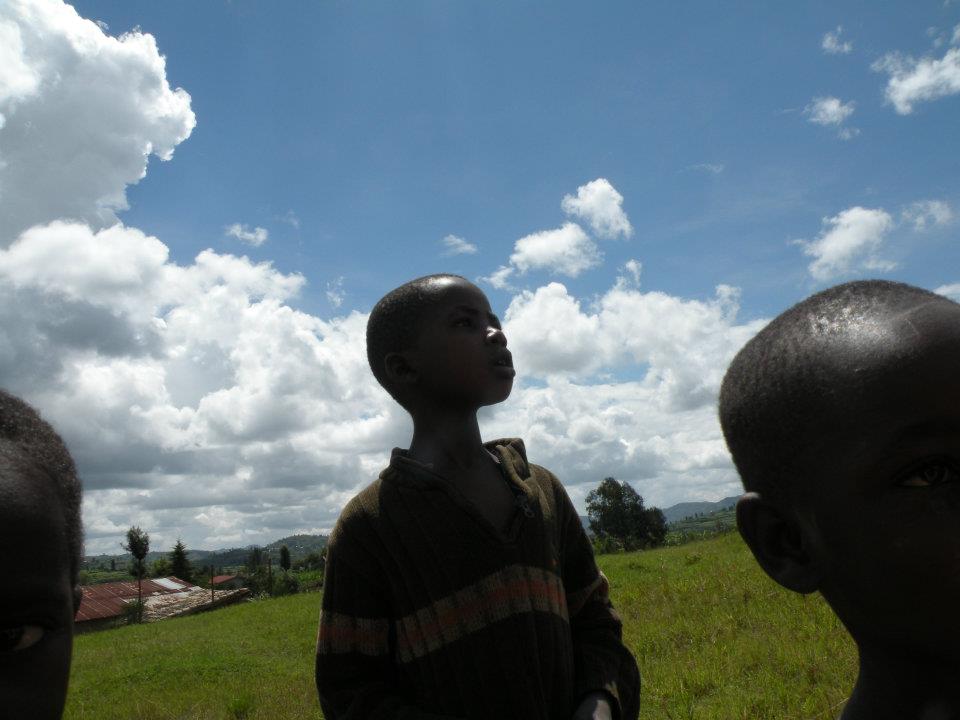
A Rwandan Boy Standing on the former site of the Murambi Technical School where an estimated 45,000 people were murdered in 1994.

I was frustrated by their utilitarianism, exhibited all throughout the trip from their views on “overpopulation” to their excuses for all sorts of government intervention. It was especially disconcerting as I sought to discern and affirm the dignity of human life amid studying the horrors of genocide. I sought to understand what a genocidaire who slaughtered people he had in common with an adorable grinning African child, waving to us on the side of the street and calling out, “Muzungu!” – that we should call both of them persons.

When I read the scene of the student and the young officer in the restaurant, I recalled the scene in Machiavelli’s “Mandragola” where Ligurio aims to persuade Friar Timothy to procure an abortion for a young, unmarried woman. He says:

What is there to think over? Just look at how many good things will flow from this action. You’ll maintain the honour of the convent, of the girl and her relations; you’ll restore a daughter to her father; you’ll be doing a favour for his Honour, for all his relations; you’ll do as many good works with these three hundred ducats as you can. And on the other hand, you’re not harming anything except a bit of unborn flesh, devoid of feeling, that could be lost in a thousand ways. And I do believe that a deed is good when it is good for the majority and the majority is happy with it.”

Here is foreshadowing of the doctrines of pleasure-maximizing and the “greatest-happiness principle” that would be promoted by utilitarians Jeremy Bentham and John Stuart Mill.

The next section of Crime and Punishment that had the greatest impact on me is where Raskolnikov describes his desire to be a Napoleon and to “do everything in a big way.”

“All right. So be it! It was like this: I wanted to make myself a Napoleon: that’s why I murdered…  Well, now do you understand? […] It’s like this. Once I asked myself a question sort of like this: suppose Napoleon had been in my place, without Toulon or Egypt or the passage across the Mont Blanc to launch his career, but instead of those beautiful monumental, epoch-making events there had simply been some absurd old hag, a stinking clerk’s widow, and she had to be killed so he could steal some money from her trunk (for his career, mind you) – well, suppose there had been no other way – would he have brought himself to do a thing like that? Would he have shrunk back because it wasn’t monumental enough, because it was … sinful? Well, as I say, this ‘question’ tormented me for a terribly long time, so I felt horribly ashamed when it finally occurred to me – all of a sudden, somehow – not only would he not have shrunk back, it would never have occurred to him that what he was doing wasn’t monumental … and he wouldn’t have understood what there was to shrink back from.”

This was a bit startling to me since I had recently been considering the relationship between great and pivotal events and great and pivotal people. I have thought about this concerning saints. Would they be saints in more ordinary circumstances or does the greatness of their suffering and their circumstances help to make them holy people? It’s a bit of a different sort of question, but still related. And it is the wrong view to take, of course, since it is not their greatness, but the greatness of God in them, as all the saints would surely say. God’s grace is the source of the saints’ magnanimity.

On another note, the idea of wanting to be exceptional does not seem that extraordinary. “What writer or scholar hasn’t started out by trying something original!” one character asks Raskolnikov rhetorically. These days it seems to be enough for many to be granted the illusion of exceptionalism, such as when every student gets a gold star or when an entire class graduates with “highest honours.” Maybe the illusion suffices to maintain mediocrity to the extent that individuals do not seek to prove or assert their exceptionalism?

As I travel the United States, I cannot resist thinking about Alexis de Tocqueville who came from France to the United States in 1831 with a friend. He was 25 years old, only a few years older than I am, when he made his journey. He was on assignment by the French government to study the American prison system, but seized the opportunity to study broader American society and eventually wrote his two volume work Democracy in America.

Then, I read an article by professors Barry Cooper and John von Heyking about Eric Voegelin and George Grant. They write:

“Voegelin and Grant had in common the biographically unique encounter of a foreigner with the United States. For both men, that experience was critical and significant. Moreover, both were aware of the link between biography and philosophy; both knew that [biographical] consciousness was somebody’s philosophical consciousness. That is, concrete human beings, with specific and identifiable names such as George Grant and Eric Voegelin, participate in the order and disorder of particular times and places. Their reflections are already under way in their pre-reflective experiences of participation in the here and now of the America they knew. Looked at in terms of the accounts they rendered of their participation in the reality of America, what they said was also an account of how they understood themselves. In order to see their respective assessments of the United States, it is first necessary to consider where they were standing and where they were going.
[…]
Voegelin learned from his experience of the United States that political science begins from an understanding of the self-interpretation of those individuals who actually participate in any particular political order, and not from an elaborate ‘scientific’ understanding.”

John Hancock Observatory in Downtown Chicago

And so after thinking about Tocqueville, Voegelin, Grant and others, I started to ask myself: What’s happening now? Is anything exciting going on? In what ways do my travel experiences constitute a sort of political philosophizing? How will these experiences of participating in a particular political order influence my soul and shape my understanding?

Peter Kreeft’s 15th thing that philosophy is according to history’s first and wisest philosopher in Philosophy 101 by Socrates is this: Philosophy is laborious.

“Socrates calls his philosophical ‘wanderings’ ‘my own Labours’ referring to the well-known legend of the twelve labours of Hercules, the Greek Superman. […] Whether philosophy is easy, like watching a movie, or laborious, like childbirth, depends on whether you are only observing some other philosophers in action, passively, or actually philosophizing yourself, actively (either in dialogue with another or alone), and on whether you are honestly trying to find the truth or just pretending, whether you are actually thinking or just imagining that you are thinking.

Keynote Address by Eric Metaxas at Acton University in Grand Rapids, Michigan

So far, this summer has been filled with activity. I have met people from so many different demographics. I’ve met Catholics, Evangelicals, Orthodox Christians, Muslims, Jews, Atheists, Liberals, Conservatives, Republicans, Democrats, Voegelinians, Straussians, Libertarians, Rothbardians, Randians, Hayekians, Chestertonians, etc., etc. I have not read enough about all of these many religions and philosophies, yet it is wondrous how I come to learn about them through meeting people who identify with them or subscribe to them in order that I might form an initial impression on the philosophies themselves.

I’ve met people who have attended public schools and private schools, people who were homeschooled and unschooled. I’ve been inspired to strive for excellence, especially by students from St. John’s College, Louisiana State University, Universidad Francisco Marroquin, Grove City College, Ave Maria University, and Thomas Aquinas College and by phenomenal professors and guest lecturers who I have had the privilege of learning from all summer.

It can be easy to be enamored with whatever ideas and institute I am acquainted with at the time, but attending so many summer seminars back to back affords me some distance and helps me to judge everything more carefully.For Tocqueville and his travel companion Beaumont:

“The purpose of their journey became more precise. It would concern a double and simultaneous intellectual journey whose subject would be France as well as America. ‘I will admit to you that what most prevents me from knowing what is happening on this point in America,’ wrote Tocqueville to his friend Blosseville, ‘is being almost completely ignorant of what exists in France.'”
I can relate to this. The more that I learn about America, the more that I realize how ignorant I am of Canada. Tocqueville was from France and I am from Canada. We are both foreigners coming to gain insight in a country not our own. And for foreigners, some tension seems to exist between the depth and insight achieved through immersion and the critical and reflective perspective of an outsider.

Sometimes while I travel, I observe in myself a desire to elevate my experiences, by comparison to those of others and to historical examples. It’s easy to fall into thinking that lots of commotion makes people better. I am reminded of a conversation I had with a member of the Canadian military who conveyed his surprise that the busiest times when citizens enlist are after a soldier dies. I can see how the question: What if I lived in more interesting times? quickly becomes: I shall change the times and make them more interesting. And as history and as Raskolnikov show, this desire to transcend monotony is dangerous and even disastrous when the actions are not well-ordered and lovingly directed.

There is profundity in the simplicity of what Mother Teresa says: “We can do no great things, only small things with great love.” And I have been reflecting on this very insightful observation of C.S. Lewis: “Doesn’t the mere fact of putting something into words of itself involve an exaggeration?”

G.K. Chesterton wisely says:

“I am ordinary in the correct sense of the term; which means the acceptance of an order; a Creator and the Creation, the common sense of gratitude for Creation, life and love as gifts permanently good, marriage and chivalry as laws rightly controlling them, and the rest of the normal traditions of our race and religion.”
[…]
“In short, the democratic faith is this: that the most terribly important things must be left to ordinary men themselves–the mating of the sexes, the rearing of the young, the laws of the state. This is democracy; and in this I have always believed.”

C.S. Lewis Statue in Belfast

Similarly, C.S. Lewis says:

“It is easy to think the State has a lot of different objects – military, political, economic, and what not. But in a way things are much simpler than that. The State exists simply to promote and to protect the ordinary [emphasis mine] happiness of human beings in this life. A husband and wife chatting over a fire, a couple of friends having a game of darts in a pub, a man reading a book in his own room or digging in his own garden – that is what the State is there for. And unless they are helping to increase and prolong and protect such moments, all the laws, parliaments, armies, courts, police, economics, etc., are simply a waste of time.”

I had read an introduction to Nietzsche’s Thus Spoke Zarathustra and saw the connection between it and the scene where Raskolnikov explains the motivation for his crime to Sonia. Crime and Punishment was read in preparation to read Nietzsche. Before reading Crime and Punishment, I had just read C.S. Lewis’s beautiful and important book The Abolition of Man. The central idea in it is that: “Man’s conquest of Nature turns out, in the moment of its consummation, to be Nature’s conquest of Man.”

That single line, I think, has been the most important thing to keep front of mind while reading these books and living ordinary life. There is a need for humility, for a “right response to reality” (Kreeft), for an effort toward “attunement to the order of being”, and for a golden mean or “balance between the claims that the immanent and transcendent dimensions of human experience make on the human being who lives ‘between’ them.” (Webb on Voegelin)

I have now taken to underlining the words “order” “disorder” and all their various forms in every text that I read. If you flip through my copy of Crime and Punishment, the marginalia will be a testament to what Anne Fadiman describes as a “carnal love” of books. She writes:

“A book’s physical self was sacrosanct, its form inseparable from its content; her [the Danish maid’s] duty as a lover was a Platonic adoration, a noble but doomed attempt to conserve forever the state of perfect chastity in which it had left the bookseller. The Fadiman family believed in carnal love. To us a books words were holy, but the paper, cloth, cardboard, glue, thread, and ink that contained them were a mere vessel, and it was no sacrilege to treat them as wantonly as desire and pragmatism dictated. Hard use was a sign not of disrespect but of intimacy.”

I will look back on this first reading and probably laugh at what struck me, the connections that I drew, the responses that I made, and on how little I grasped. I had a philosophy professor who once told me that he has a handful of books, including several Shakespearean plays, which he reads again and again. Every ten years or so he buys a copy of the text to read and then compares his notes across the years. The books don’t change, but he does. It is the same with going to Mass. Why go to Mass every week? The Mass doesn’t change, but we do.

In her afterward, Robin Feuer Miller poses these questions (among others) to the reader:

What does the novel now mean to you? What does the fact that you have taken the time to read this long novel mean to you in terms of priorities in your own busy life? Has the immensely private act of reading made you more thoughtful or more compassionate, or has it hardened your heart? How will this novel insert itself into the private recesses of your living, thinking, feeling self? Will having read Crime and Punishment make you a better citizen?

They are such excellent questions that they are probably the sorts of questions better answered by one’s life than by one’s words.

The Introduction by Professors Leonard J. Stanton and James D. Hardy Jr. piqued my interest. In it the professors discuss the parallels between Dostoyevsky’s Crime and Punishment and Saint Augustine’s Confessions since: “The great Christian novel parallels the great Christian autobiographical spiritual journey.”

They are stories of the soul’s return to Truth and to Love. The introduction ends with this:

“The readers of Crime and Punishment know what that reality is. It is the ‘subject of a new tale,’ one in which Raskolnikov’s heart is at rest, in which he gives over being the theorist of the ‘new word’ and becomes the bearer of the true Word.”

In the Gospel, Mary and Martha “sent a message to Jesus, ‘Lord, he whom you love is ill.’ But when Jesus heard it, he said, ‘This illness does not lead to death; rather it is for God’s glory, so that the Son of God may be glorified through it.’” (John 11)

Philosophy is filled with paradoxes because the truth is often paradoxical. How do we combat the desire to innovate, to contrive new theories, and to transcend nature? Perhaps “Be extraordinary!” is a silly thing to say to encourage young people. Perhaps it is better to encourage them to be ordinary, keep the commandments, love order, seek truth, “to do justice, and to love kindness, and to walk humbly with your God.” (Micah 6:8)

Statue of St. Augustine in Dublin

There is freedom in truth. There is freedom in the embrace of the order of history, in passion (suffering), death, and resurrection. The order of the soul’s journey mirrors the order of history. The individual life is a microcosm of salvation history. Like Saint Augustine wrote so beautifully, “Late have I loved thee! Too late came I to love you, O Beauty both so ancient and so new! Too late came I to love you – and behold you were with me all the time . . .”, we come to realize that we are part of order, and never outside it, beyond it, or above it.

St. Augustine and St. John the Baptist Church in Dublin, Ireland

We are mysteries to ourselves and we often do the things we hate. We easily confuse created things for the Creator because we are creatures, but in God’s image we also have the dignity of co-creators. That is, the dignity to bring forth new life and creative ideas, but not, as in Crime and Punishment, “a new word.” For “In the beginning was the Word, and the Word was with God, and the Word was God. All things came into being through him, and without him not one thing came into being.” Like John, we must respond to this gift by affirming that we are not the light, but we live to testify to it.

In Crime and Punishment and in all my experiences of learning and travelling, there is the consistent and beautiful affirmation that, as Tolkien says, “We make still by the law in which we’re made.”

In gratitude for her excellent afterword in my edition of Dostoyevsky’s Crime and Punishment, this post is dedicated to Robin Feuer Miller and to all professors who patiently journey with their students in search of truth.
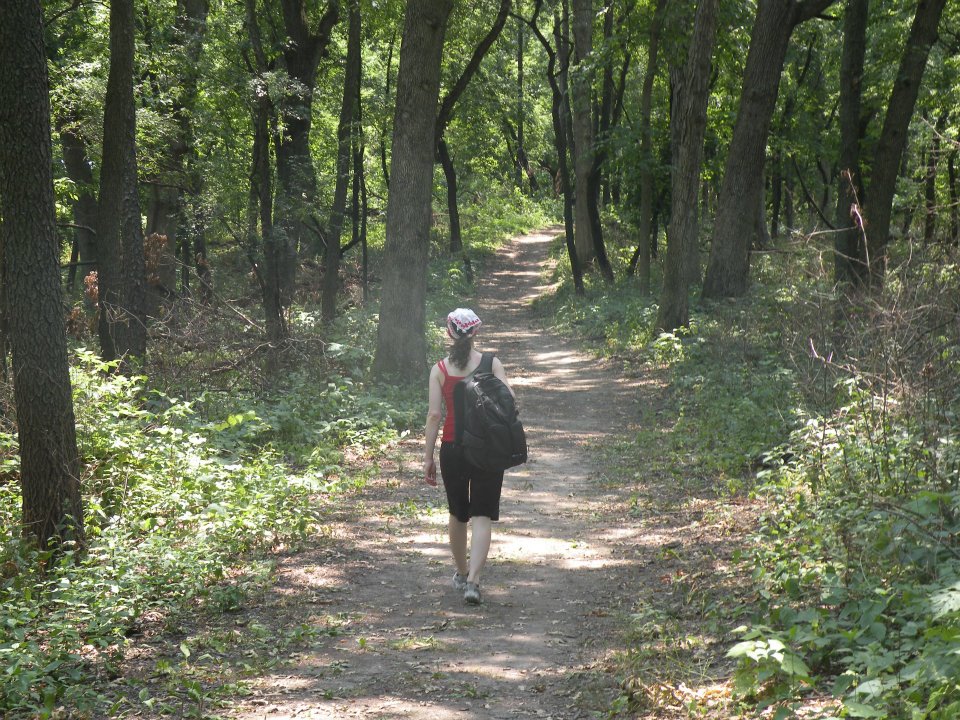
Hiking at Volo Bog State Natural Area in Northeastern Illinois.

Fortnight for Freedom: The Battle for Religious Liberty in America

Throughout the United States, American Catholics are participating in a Fortnight for Freedom. This two-week period, an initiative of the United States Conference of Catholic Bishops, is a national campaign for religious liberty. The campaign comes at a time during which “[o]ur liturgical calendar celebrates a series of great martyrs who remained faithful in the face of persecution by political power— St. John Fisher and St. Thomas More,  St. John the Baptist, SS. Peter and Paul, and the First Martyrs of the Church of Rome.” Additionally, the campaign is a period of prayer, fasting, civil disobedience, and other activities devoted to defending religious liberty.

Religious liberty is under attack in more realms than one. The current focus, however, is on the Department of Health and Human Services mandate, which forces the Church to provide coverage for abortion inducing drugs, contraceptives, and sterilizations. The Supreme Court is currently ruling on the constitutionality of the healthcare policy on the grounds of enumerated powers. Other challenges have been brought forth on the grounds of the First Amendment also. According to this article, “forty-three Catholic dioceses and organizations across the country have announced religious liberty lawsuits against the federal government to challenge the Obama administration’s contraception mandate.”

I attended mass at St. Mary Catholic Church in Huntley, Illinois yesterday on the Solemnity of the Nativity of Saint John the Baptist and on the First Sunday in the Fortnight for Freedom.

Fr. Jonathan Bakkelund delivered the homily. He spoke with great fervor and urgency on the issue of religious liberty.

He began by discussing the history of religious persecution in America. Then, he said, “This is not a republican or a democratic, a conservative or a liberal issue. This is not a Catholic issue.This is not a Jewish issue. This is not an Orthodox, Mormon, or Muslim issue. This is an American issue which threatens the God-given, inalienable rights of every Muslim, every atheist, every man, woman, and child of this great nation. This is an issue of Religious Liberty.”

He explained that so-called accommodation in the mandate for religious employers.
“To qualify for an exemption, you must employ primarily those of your own faith, and serve primarily those of your own faith.  Parishes would be exempted, but Catholic hospitals, universities, charitable groups, relief organizations, and publishing houses would all be excluded. […] It’s never been the government’s job to tell us which babies we can clothe or whose mouths we can feed…it’s never been the government’s job to tell us we’re gonna have to start asking for baptismal certificates at the door.”

In this video, Bishop Joseph R. Cistone says, “The word accommodation is a strange one to me. We have a right to religious freeedom. And so that right has been infringed upon. And now we hear of an accommodation to protect us from that infringement. We want to go back to the right itself. There is no need for an accommodation.”

Fr. Bakkelund continued, “If you study your history books well, every single epic in the history of the world when the Almighty State has attempted to privatize religion, and force her into seclusion, removing her from the public square… every single one of these epics has seen the degradation of the human person.”

He spoke sincerely saying, “As a young priest, I pray, God willing, to serve Our Lord and His Church as a priest for the next fifty years. I am deeply concerned that in those fifty years I could see my work and my ministry become illegal.”

He ended with the following quotation of Pope Saint Pius X:
“Kingdoms and empires have passed away; peoples once renowned for their history and civilization have disappeared; time and again the nations, as though overwhelmed by the weight of years, have fallen asunder; while the Church, indefectible in her essence, united by ties indissoluble with her heavenly Spouse, is here to-day radiant with eternal youth, strong with the same primitive vigor with which she came forth from the Heart of Christ dead upon the Cross. Men powerful in the world have risen up against her. They have disappeared, and she remains. Philosophical systems without number, of every form and every kind, rose up against her, arrogantly vaunting themselves her masters, as though they had at last destroyed the doctrine of the Church, refuted the dogmas of her faith, proved the absurdity of her teachings. But those systems, one after another, have passed into books of history, forgotten, bankrupt; while from the Rock of Peter the light of truth shines forth as brilliantly as on the day when Jesus first kindled it on His appearance in the world, and fed it with His Divine words: “Heaven and earth shall pass, but my words shall not pass” (Matth. xxiv. 35).”

The entire congregation stood and applauded this message. It was the first time in my life that I have heard a homily that roused the whole congregation to such a response.

Check this out:

Foundation for Economic Education – Liberty and the Moral Adventure

This week I am attending a Foundation for Economic Education summer seminar for college students. The seminar, which draws an international mix of students, takes place in Atlanta, Georgia. The Foundation for Economic Education is the oldest free-market organization in the United States. Founded in 1946, the Foundation has a long legacy of promoting its mission:

FEE’s mission is to offer the most consistent case for the “first principles” of freedom: the sanctity of private property, individual liberty, the rule of law, the free market, and the moral superiority of individual choice and responsibility over coercion.

This years marks the 50th anniversary of FEE seminars. Students selected to participate receive a fully-funded seminar experience courtesy of FEE and from the generosity of private donors. The seminar that I am attending is on current events. Throughout the week we have been listening to lectures and engaging in debates on such topics as: healthcare, immigration, the environment, taxation, monopolies, education, the welfare state, foreign intervention, and urban planning.

The seminar began with a lecture by FEE President Lawrence Reed. He delivered a lecture titled: Seven Principles of Sound Public Policy. He began his talk with a fun story called the Louisiana Land Title legend. Then, he proceeded to share with us the inspiring story of entrepreneurship of Will Kellogg.

The first principle of sound public policy that Lawrence Reed outlined is: Free people are not equal and equal people are not free. By this he is not referring to equality before the law or equality in terms of human dignity. He is referring to the natural inequality of talents and initiative found among human persons. He highlighted the contradiction in proclaiming “Vive la différence!” while, at the same time, seeking to promote egalitarian socialism. Socialism is a proposal to make people what they, by nature, are not. The socialist starting point is an utter fiction about the human person.

Lawrence Reed spoke to us a bit about incentives. Nobody takes care of somebody else’s property as carefully as he takes care of his own, Reed explained. “Have you ever heard of someone washing a rental car?” he asked. Reed shared with us a story about a club that he belonged to that would meet regularly at a restaurant for dinner. For the sake of simplicity, the bill would be divided evenly between the members equally. However, soon they began behaving like socialists. Members began ordering the most expensive meals on the menu because of the knowledge that their fellow members would be subsidizing their meals. When members began ordering lobster (subsidized when the bill was divided by those who ordered ceasar salad), the club became known as The Lobster Club.

Copies of the constitution were pulled out during our lunchtime debates.

Liberty is what makes us human and liberty makes life worth living, said Reed. We should aspire to be the unique and sovereign individuals that we were created to be. With liberty, we can be what we are. And “the happy life is joy in the truth.” We fufill our human purpose by living in accordance with the truth of who we are. Reed said that in 1776, government was dethroned and that, depending on our view, the creator or the individual was put in the place of government.

Anybody can be a socialist, explained Reed. All that it takes is wanting something that doesn’t belong to you and encouraging the use of coercion to get it. Liberty, on the other hand, requires that we live up to some pretty high standards. Liberty is an indispensible condition for a life of virtue. Reed encouraged us to strive to advance liberty. “Be special. Be different. Be an example.” Let us embrace the moral adventure, advancing liberty for the sake of freedom for excellence.

Thank you to everyone at the Foundation for Economic Education and to Jim Beley for making this opportunity possible.

Acton University: Day 2 – Foundations

This was my first year at Acton University and so I was enrolled in the foundational lecture series. The foundational lectures for first timers included: Christian Anthropology, The Christian Vision of Government, Economic Way of Thinking, and Biblical Foundations in Freedom.

Looking back on Acton University overall, the main lesson that I take away is the importance of a good anthropology, of a proper understanding of the human person. Thomas Aquinas began his work On Being and Essence by quoting Aristotle’s De Coelo: “A slight initial error eventually grows to vast proportions.” If an error is made at the outset, then subsequent statements will be improperly concluded. This alerts us to the importance of being grounded firmly in true starting points, in solid philosophical foundations.

During Dr. Matheson-Miller’s foundational lecture, he told us that John Paul II said, “The primary fault of socialism was anthropological in nature.” “What [Pope JPII] meant,” explained Dr.  Matheson-Miller, “is that socialism failed because it got the person wrong.”

Dr. Matheson Miller stressed the issue of the common acceptance of the Rousseauian account as an alternative to the creation narrative in Genesis. “Individualism is false,” Matheson-Miller said, “We are born into families.” It is a totalitarian tendency rather than an expression of liberty to impose our relentless fictions on the nature of reality. He also maintained that there are no individuals, but only human persons. The family is a natural community that is pre-political. It is not a construct, but a biological and social reality, he explained.  

Biblical theology and Greek philosophy are the pillars of western civilization. In Greek philosophy we have the Socratic recognition of the limits of knowledge in the story of the Delphic oracle. In biblical theology, we have the Judeo-Christian recognition of the limits of human goodness in the story of creation and the fall. G.K. Chesterton called original sin “the only provable Christian doctrine.” Socrates affirmed his own ignorance. The humility necessary to recognizing limits is a unifying aspect of both biblical theology and Greek philosophy.

Peter Kreeft says that we come to know truth by its goodness, but that goodness is ontologically dependent on truth. The paradoxical nature of Christianity is easier to reconcile when we see that our philosophical tradition equally attests to a humble recognition of limits so as to grow in knowledge and holiness in order to lead lives worthy of men on earth.
Retaliation against biblical theology for its account of the weakness of human nature is an equally problematic retaliation against western philosophy. In both cases there is a rejection of the limits of knowledge. This tends consistently to boundlessly rationalistic system construction oriented to perfection that cannot be attained because, as Genesis and Thomas More have illustrated, of human pride.

If we could achieve perfection in knowledge, would we not be able to be perfectly good? If we could achieve perfection in our goodness, would it not be through the perfection of our knowledge? And yet, as St. Paul expressed so succinctly, “I do not understand my own actions. For I do not do what I want, but I do the very thing I hate.” Like Augustine we are confronted with the perplexity that arises when we realize that we have become mysteries to ourselves. Augustine confesses, “For in your sight I have become a riddle to myself and that is my infirmity.”

What does it mean to be a person? What is human nature? These questions are fundamental and they matter for every discipline and for every person. Modern rationalism, system construction, and freedom apart from human excellence are roadblocks to arriving to the beauty, goodness, and truth of the Christian anthropology. Let us take all of the other anthropologies and test them against the Christian account of persons as images of God, who discover true liberty when they love the law that God has written upon their human hearts… that they might abide in Him and be loved by Him, held in His Order and Truth.

In gratitude for his good lectures and advice, this post is dedicated to Dr. Michael Matheson-Miller.

Acton University: Day 1 Kick-off with Ambassador Novak

Acton University is a four-day exploration of the intellectual foundations of a free society. An initiative of the Acton Institute, Acton University draws hundreds together in Grand Rapids for an ecumenical conference on morality and markets.

During the flights, I alternated between reading Dostoyevsky’s Crime and Punishment and conversing with my fellow travelers. (And by that I do not mean fellow travelers in a communist sense but fellow travelers in the sense that there were interesting people on the plane with me.)  

Upon arrival to the airport, I struck up a conversation with a young woman named Sarah-Beth. She is a Master’s student at Louisiana State University. Making the typical introductions, we learned that we have a great deal in common. We are both studying political science with an emphasis on political theory and we both take a great interest in bioethics.

After registering at the conference, I settled into the hotel. There I met my roommate Tessa from Seattle. She studied international relations and now works at a think tank called the Discovery Institute.  We discussed American and Canadian politics and quizzed one another on the historical basics of our respective countries. After she kindly converted the forecast into Celsius on her computer for me, we got ready and returned to the Devos Convention Centre for dinner.

“Power corrupts and PowerPoint corrupts absolutely.” – Dr. Samuel Gregg

The room was filled with more than eight hundred conference attendees from about eighty different countries. Acton Institute Research Director and emcee for the evening, Samuel Gregg noted the diversity of attendees highlighting that there were Catholics, Protestants, Jews, Muslims, Orthodox, and Straussian participants. In fact, this was my first conference during which people teased one another about being Straussians or Voegelinians.

After Dr. Gregg’s introductory remarks, Acton Institute Founder Fr. Robert Sirico hosted a conversation with Ambassador Michael Novak. As a theologian, author, and former United States ambassador, Novak brought a wealth of experience, insight, and joy to share with all of us.

Ambassador Novak reminded me of Preston Manning. Novak spoke about his life, work, and faith in a manner that was humble, down-to-earth, and friendly. He spoke about growing up in poverty and said that he wrote articles to make enough money to get by. Novak said that he became a critic of the left from the left and did not have a road to Damascus conversion to conservatism. He noted that it was initially because of the abortion issue that he became a Republican. A lover of truth and order, Novak learned that there is not a need to have a command system to achieve order. In fact, such systems are essentially opposed to ordered liberty.

Ambassador Novak became frustrated with liberation theology and was inspired to begin insisting to people: Show me how liberation theology helps the poor. He discovered that it doesn’t.

Novak described his experience of losing friends over his principles and clashing with his own publisher who argued against publishing his book with “capitalism” in the title. Yet, The Spirit of Democratic Capitalism became his greatest masterpiece and was published underground in Poland in 1984, and after 1989 in Czechoslovakia, Germany, China, Hungary, Bangladesh, Korea, and across Latin America.

The best indicator of genuine development, explained Novak, is how many small businesses are being created. He insisted that education, low-interest credit, and the ability to incorporate businesses quickly and cheaply are among the key development solutions oriented toward promoting human flourishing.

A question was posed to Novak about Vatican II. Ambassador Novak said that he was in favor of the mass in the vernacular, but reminded us that it was not expected that the Latin would perish. He emphasized the elevation and succinctness of the Latin that requires a special mental discipline and contributes to the liturgical beauty. Novak said that people who do not experience the Latin mass are likely missing out. He also made a few remarks on his general views of the English language; he called English “a down-to-earth language with a natural Aristotelian bent.”

After his keynote, I had a few minutes to visit with Ambassador Novak. He grasped my hands in a warm, grandfatherly way. I told him that when I was in Cuernavaca in Mexico, I insisted on a Spanish speaker translating a few pages of his book Will it Liberate? aloud to me. I told him I was starving for some common sense in order to help me deal with the troubling liberation theology that I had confronted down there during Easter. He smiled and said, “Who would have known that my book would help put a pretty young woman to sleep?”

In the evening, I visited with many of the Acton University attendees. We discussed theology, politics, economics, history, the evening program, and the sessions that we anticipated in the week ahead. It was energizing to be among a crowd of people so motivated in striving for a civilization of love, a culture of life, and a free and virtuous society.

Global Vision’s National Youth Ambassador Caucus in Ottawa

Global Vision is an organization that was created in order to train young Canadian leaders. Terry Clifford founded the initative in 1991 while he was a Member of Parliament. Global Vision has trained more than 25,000 Canadians, many of whom have travelled on economic trade missions to represent regional and industry-related interests abroad.

I arrived to the Ottawa Residence Commons Building (or “90 U” as it is called here). The building was familiar because I had toured it when I was discerning which university I would attend. Though I did not choose to pursue a degree here, I was excited to be staying on campus for the weekend. Conferences and events provide the opportunity to be a student at many more places than one could possibly study formally. It is a delight to taste the student experience in different contexts.

In the evening I chatted with a former Sudanese refugee, a former Yugoslavian refugee, ate poutine, drank St-Ambroise, and debated abortion, national parks, and prison spending. It is always good to return to the nation’s capital!

Jacob, from South Sudan, told me his story. He was separated from his family when he was seven years old and spent fifteen years in a refugee camp. He lamented the lack of opportunity, belonging, and purpose among the youth in his country. I proposed that the student protesters in Montreal have, to a different degree, a similar lack of purpose and belonging. Jacob agreed with the comparison. We then discussed the urgency of having worthy aims to strive for, goals towards which one can direct passion and from which one can derive meaning.

My new friend Vanja, who was born in former Yugoslavia, also had some good stories. Realizing my interest in refugees and immigration, he took out his BlackBerry and showed me an image of his Grade 2 class list. “When I was a refugee in Germany,” he began, “I lived in a small town and the phone numbers were only four digits. Here is a class list. What do you notice about the names of those students who have no phone numbers listed?” He explained that he and the other immigrant families were not allowed to have telephones. He also told a story of an apartment occupied mostly by immigrants that was graffitied with the words, “Immigrants Out!” Police did not respond to complaints about this. Yet, when some of the immigrants graffitied a nearby garbage bin with the words, “Germans In!” the police prosecuted the vandalism. It was amazing to be hearing this from someone my own age. I take Canada for granted.

On Sunday morning we had a scavenger hunt in Ottawa. The Amazing Race included such tasks as: Get a Business Card from Any Establishment on Bank Street, Take a Photo with a Server from Zak’s Diner, Bring Back a Penny from 1974, and Find Out How Many Rooms are in the Château Laurier. (There are 684 rooms. Also, the 100th anniversary of the Château Laurier was celebrated on Friday.)

I went to mass at Notre Dame Cathedral. The church was overflowing with congregants and fifty teens were confirmed during the noon mass on the Feast of the Holy Trinity.

In the afternoon we listened to: John Treleaven, a former Canadian ambassador to the Philippines; Terry Clifford, the founder of Global Vision; and Jacob Deng, Founder of Wadeng Wings of Hope.

The following day, our first guest speaker was Julie Marshall from the United Nations World Food Programme. I challenged her to address the problems of foreign aid perpetuating dependency, distorting local markets, and being unsustainable. Naturally, she shot back in desperation asking, “What’s the alternative?” Her entire focus was on food security. How can people who love life and liberty work to promote true solutions to global hunger and advance food freedom?

In the afternoon we listened to Jean-Francis (JF) Carrey, one of the youngest Canadians to climb Everest. He encouraged us to “flirt with our dreams.” He did this by making an initial visit to Nepal during which he traced some of the steps of Edmund Hillary, the first man to summit Everest.

Then, JF made a t-shirt with a photo of Everest on it. “Then my goal was on a t-shirt. I had no choice but to do it since it was on a t-shirt!” said JF.

Since JF had to raise $100,000 to pursue his goal, he says that he went to dozens of events and associations. “I was going to these networking events… women in business, you name it,” he said.

JF noted that we are always reminded how dangerous things are and how people before us have failed. So we need to know what it is that sets us apart he figures. JF says that climbing Everest was not fundamentally about getting to the top but rather to experience the beauty of the sunrise at the summit. Still, JF stressed, “The summit was the cherry on top of the sundae. I encourage you to enjoy the journey.”

Another excellent speaker was Deepak Obhrai, a member of parliament. He was born in Tanzania and says that it was the socialist policies in Tanzania after the country gained its independence that is the reason for his conservatism. “That was a lesson in not being a socialist and that’s why I am a conservative,” he said. Addressing his decision to be a leader in Canada rather than in Africa, he said that Tanzania’s policies drove him out and that Tanzania’s loss is Canada’s gain. Deepak went to a school on a visit to Tanzania and asked, “How many of you would like to come to Canada?” About ten students raised their hands. “Who thinks that they could become an elected official in Canada?” he asked. Not one student raised his or her hand. “You can do it,” he told them. “I did.”

Policies of socialism and protectionism drive people out when they do not succeed in merely trapping people within. The hope for the future lies in free markets and globalization. Student attendees at this conference were encouraged to travel the world. Many of the speakers said that this is the best way to depart from the usual tendencies that students have towards protectionism and socialism.

After the conference had formally ended, I joined some of my friends who are interning for the Conservative Party of Canada at a military fundraiser event.
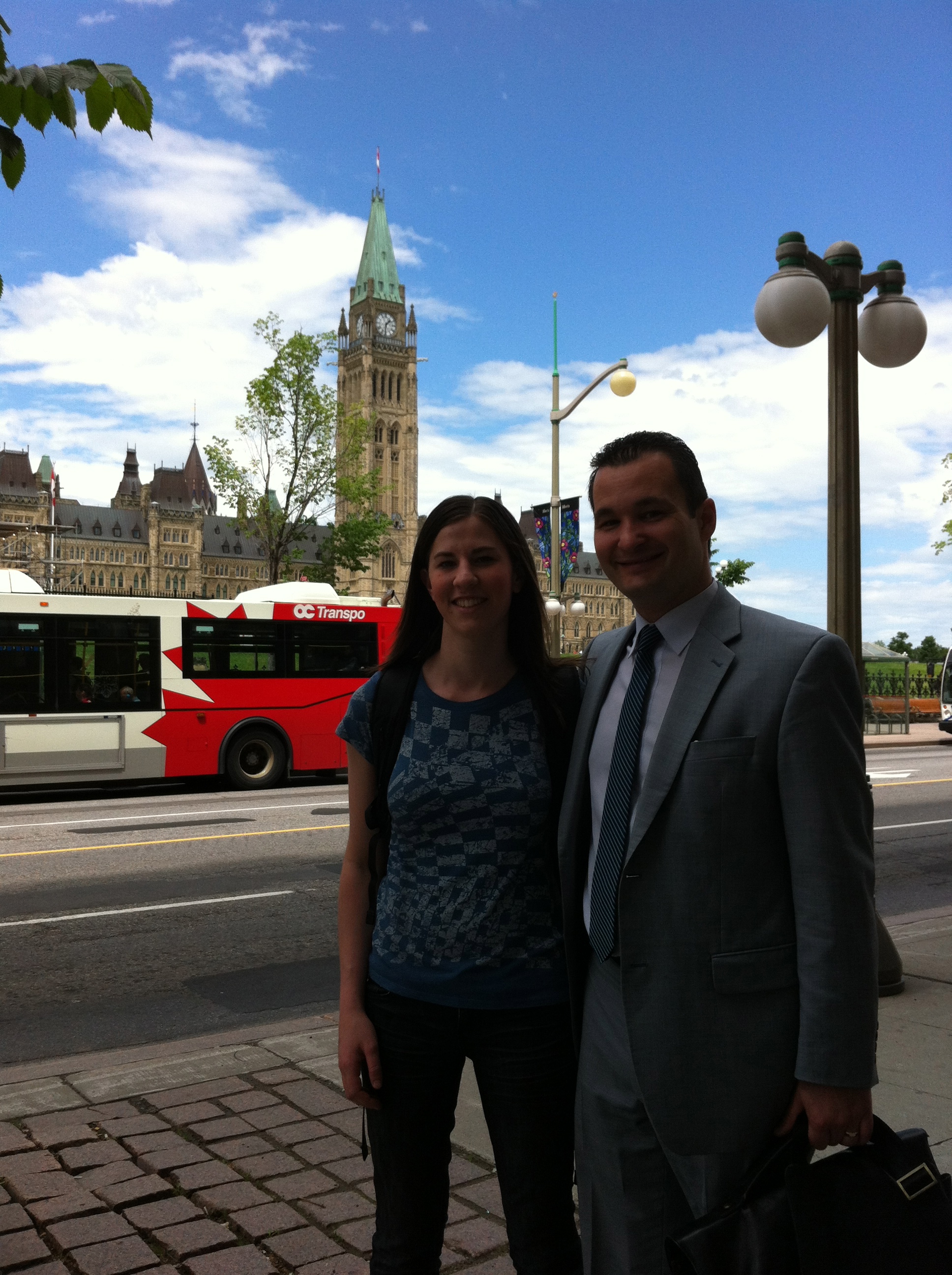
The following day I had lunch with my friend Matthew. Then, I saw some news reporters. As I walked by I exclaimed, “Radio Canada!” They said, “You speak French? Let us interview you!” Well, I am conversational in French, but speaking on television might be a stretch. They insisted, “You can do it!” So I asked: What is the issue of the day? It turned out the latest issue was a new casino in Ottawa. And so I made a few comments briefly in French about government’s addiction to casino revenue.

I enjoyed strolling downtown Ottawa on an beautiful summer day. Another highlight was running into one of my favorite members of parliament, MP Rod Bruinooge. He and I discussed Motion 312 and the Romney campaign briefly before he took off in his green shuttle to parliament.

This blog post is dedicated to Amy Giroux and Terry Clifford, respectively director and founder of Global Vision and to my friends who I had the privilige of visiting in Ottawa including: Mattea Shubat, Laura Mac, Matthew McGowan, Doug Chiasson, and Paul Hamnett.

Visiting Jeremy Bentham at the University College London

After learning about Jeremy Bentham in my History 200 class in first year university, I was inspired to visit his auto-icon (self-image) at the University College London. As the father of utilitarianism, Bentham argued: “Nature has placed mankind under the governance of two sovereign masters, pain and pleasure. It is for them alone to point out what we ought to do, as well as to determine what we shall do.” He promoted the “greatest happiness for the greatest number” and advocated in favour of anything that could be calculated as maximizing pleasure and minimizing pain.

Here is an excerpt from Jeremy Bentham’s Last Will and Testament:

“My body I give to my dead friend Doctor Southwood Smith to be disposed of in a manner hereinafter mentioned and I direct that as soon as it appears to any one that my life is at an end my executor or any other person by whom on the opening of this paper the contents thereof shall have been observed shall send an express with information of my decease to doctor Southwood Smith requesting him to repair to the place where my body is lying and after ascertaining by appropriate experiment that no life remians it is my rewuest that he will take my body under his charge and take the requisite and appropriate measures for the disposal and preservation of the several parts of my bodily frame in the manner expressed in the paper annexed to this my will and at the top of which I have written ‘Auto-Icon’… 

For more information on the Bentham Project at the University College London, click here.

Thanks to Dr. Marco Navarro-Génie for introducing me to Bentham and for sharing the anecdotes about his narcissistic eccentricism that prompted my visit to the auto-icon.

Reflections on Rwanda: Part X

The Reflections on Rwanda trip has been an incredible experience and I would like to encourage all eligible students who are interested to apply.

Here is some information on the program:

SHOUT Canada is a grassroots, national, not-for-profit organization administered by a volunteer Board of Governors.  Reflections on Rwanda (ROR) is SHOUT Canada’s flagship program, in the context of its primary organizational mandate, which is to help foster a generation of students with the power, voice and determination to affect change.

The ROR program was conceptualized and created in 2008 by the organization’s founding members who were all full-time students at the time. The year was spent putting together a pilot project, which came to fruition in the summer of 2009. Indeed, the group spent the better part of that summer in Rwanda visiting historical sites, solidifying relationships with individuals, as wells as governmental and non-governmental groups. The pilot project was implemented to lay the grounding for the 2010 ROR program.

On May 17th 2010, the first ROR cohort, comprised of 11 young Canadians from all corners of the country, met at London’s Heathrow Airport to be briefed about their imminent arrival in Kigali. On May 15th, 2011, the second ROR cohort landed in Kigali. In this context, SHOUT Canada is pleased to be offering the ROR program again in 2012 [and stay tuned for 2013!]

Here is some recommended reading material and films on Rwanda via the Reflections on Rwanda leadership team:

Reading Material:
1. Power; A Problem from Hell: America in the Age of Genocide
2. Des Forges; Leave None to Tell the Story
3. Melvern; Conspiracy to Murder: The Rwandan Genocide
4. Melvern; A People Betrayed: The Role of the West in Rwanda’s Genocide
5. Courtemanche; A Sunday at the Pool in Kigali
6. Hatzfeld; A Time for Machetes
7. Dallaire; Shake Hands with the Devil
8. Gourevitch; We wish to inform you that tomorrow we will be killed with our
families
9. Prunier; The Rwanda Crisis: History of a Genocide
10. Prunier; Africa’s World War
11. Hatzfeld; Into the Quick of Life
12. Thompson et al; The Media and the Rwandan Genocide
13. Temple-Raston; Justice on the Grass
14. Mushikiwabo; Rwanda Means the Universe
15. Immaculée Ilibagiza; Left to Tell

Films and Documentaries:

1. Sometimes in April
2. Shake Hands with the Devil (there is a documentary and a feature film)
3. Shooting Dogs
4. 100 Days
5. A Sunday in Kigali (based on A Sunday at the Pool in Kigali)
6. Journey into Darkness (documentary)
7. A Culture of Murder (documentary)
8. When Good Men do Nothing (documentary)
9. Triumph of Evil (documentary)
10. Ghosts of Rwanda (documentary)
11. Scream Bloody Murder (documentary with Christian Amanpour, you can view this on Youtube)
12. Africa United (New light-hearted film about Rwanda that doesn’t mention the genocide!)
13. If Only We Had Listened: The Prophecy of Kibeho

If anyone would like to ask me any questions about the trip, please email me at amanda.achtman@gmail.com

I look forward to speaking in schools, universities, churches, and other public forums about the genocide commited against Tutsi. Please contact me if you have any suggestions to this end.

Peace,
Amanda (Action) Achtman

Reflections on Rwanda: Part IX

As the programming changed from memorial site visits to meetings with current and emerging leaders who are moving Rwanda forward, we seized the opportunity to visit the Office of the Canadian High Commission to Rwanda in Kigali.

Promising that they would make an effort to avoid speaking to us in “Bureaucrat-ese”, Willow and James discussed the relationship between Canada and Rwanda. We learned that the first provost of the National University in Butare was a Catholic priest from the Université Laval in Quebec. The Canadian Catholic Organization for Development and Peace has been active in Rwanda since 1967. There are opportunities for student exchanges between Canada and Rwanda.

We also discussed the influence of the funding cuts to the Canadian International Development Agency (CIDA) on development initiatives in the country.

Then, we visited an Islamic cultural centre and school. The centre and school were a donation of the former ruler of the Libyan Arab Republic, Muammar Gaddafi. Reportedly, the centre and school were not attacked during the genocide and no one was killed there, we were told, because of fear that Gaddafi would intervene during the genocide if the Islamic centre was attacked.

Later, we spent the afternoon at a coffee shop discussing religion and genocide. The discussion was not too profound and centred mainly around the failures, to say the least, of religious leaders and lay people to lead lives worthy of their callings.

Absolutely no topic has been off limits on this trip. I admire my new friends for their courage to be challenged by controversy and their dedication to challenging others and inspiring them to reflection and action.

The next day we visited the National Commision for the Fight against Genocide. An article was written about our visit and appeared on the CNLG. Here is an excerpt from the article:

A group of 18 scholars from Canada who came for official visit to Rwanda, on Wednesday May 23, 2012 were received by the Executive Secretary Mr. Mucyo Jean de Dieu at CNLG Headquarters in Remera, Kigali.

The Executive Secretary explained to them that though the Genocide was perpetrated against the Tutsi in Rwanda, it’s a crime that concerns the whole world because it’s a crime that violates human rights. He told them that the National Commission for the Fight against  Genocide was established in 2008, but the National Unity and Reconciliation Commission had been established before the Genocide, from Arusha agreement of 93, to fight against hatr[ed] and discrimination based on cultures that Rwandans had even before…

Following that we had a meeting at the Association des Veuves du Genocide (AVEGA). AVEGA is an organization dedicated, in particular, to serving widows, orphans, the disabled, and elderly victims of genocide. Services provided range from medical aid to micro-financing grants.

Later we met with Zozo, who was a concierge at Hôtel des Milles Collines [Hotel Rwanda] during the genocide. It was a crazy experience to read his name, the day after having coffee with him, in the novel that a friend lent me called A Sunday at the Pool at Kigali. For a moment I put down the book and paused to reflect: “Whoa, we just met him!”

He was the most chipper and bubbly man. He seemed to laugh in such a way so as to stave off tears. Cracking endless jokes and speaking teasingly, we marvelled at his sense of humour while discussing the tragic events of eighteen years ago.

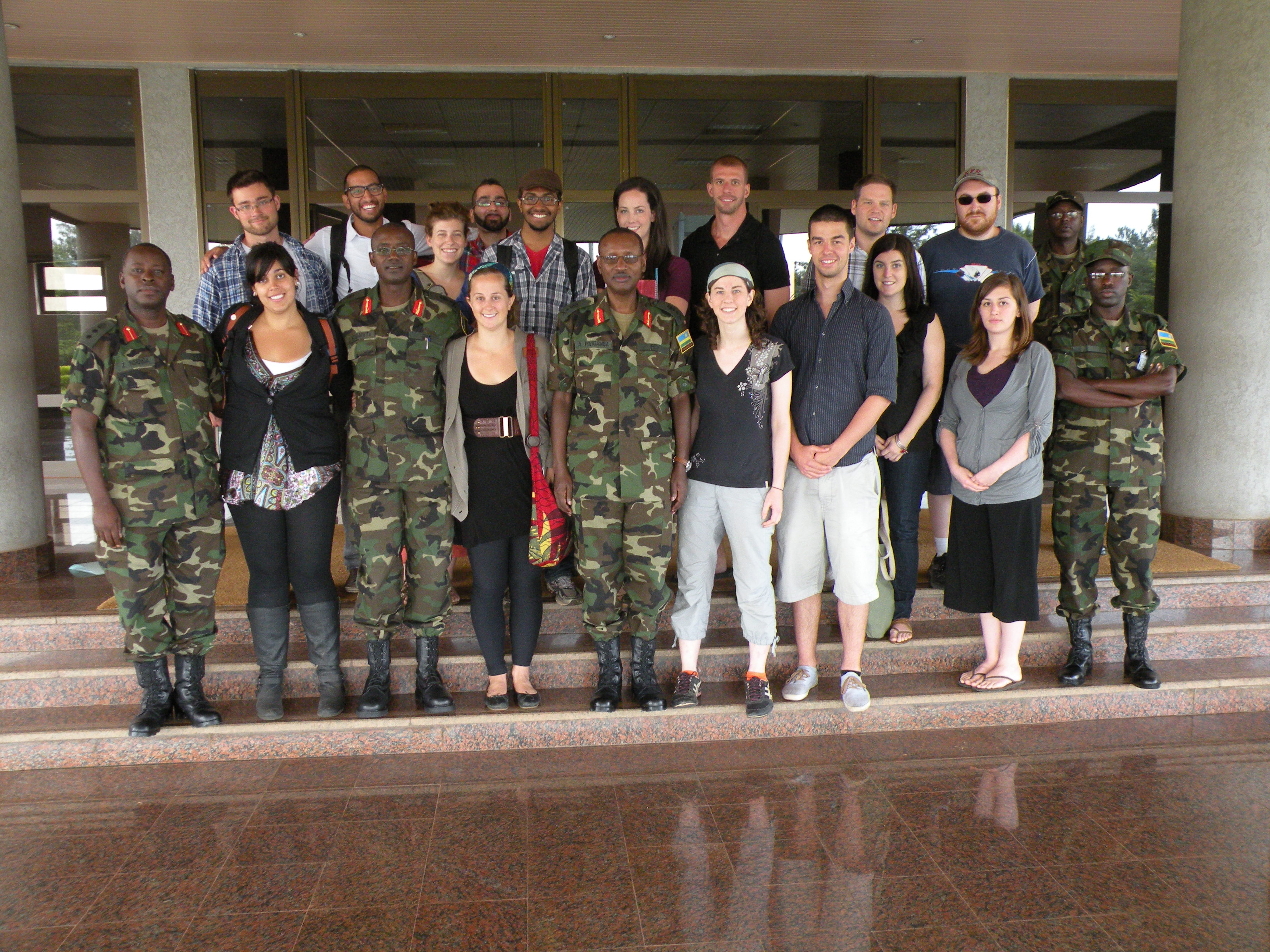
We also had the opportunity to meet with members of the Rwanda Defense Force (RDF). The military members who hosted us were extremely friendly. We felt as though we were receiving the sort of hospitality expected by lofty foreign ambassadors and not by students. The RDF members were courteous and engaged in an enriching period of questions and answers.

A neat stop on the way to lunch one day included a visit to a gift shop filled with locally-made crafts. The shop is managed by the cousin of one of the founding students of Reflections on Rwanda, and so we were especially enthusiastic to shop there for souvenirs for our Canadian family and friends.

We visited the Institut de Recherche et de Dialogue pour la Paix (IRDP), the Commission for Unity and National Reconciliation, and also attended an excellent presentation on the Gacaca courts.

Operating under the principle that “justice delayed is justice denied” it was determined that the ordinary court system would not be adequate for trying genocide crimes in a timely manner. For this reason, Gacaca courts, a form of community justice inspired by ancient tradition, were used to try genocide crimes. With ordinary courts, only 6000 cases had been heard in 5 years. But in ten years, the Gacaca courts handled two million cases.

There are three tiers in the Gacaca system. The first level concerns organizers, leadership, and planners in genocide. The second level concerns those who executed orders. The third level concerns property-related cases. In most cases, it was ruled that property stolen simply be returned or compensated. Immediate confessions often led to reduced sentences. Sometimes a perpetrator would receive the option to complete half of his or her sentence in prison and the other half in community service. The Gacaca courts are set to close on June 18, 2012.

The people of Rwanda have made tremendous strides and the country is developing at an impressive pace. After spending one week focused on the past and the second week focused on the present and looking to the future, I have certainly learned a lot.

Thank you to everyone who contributed to making this trip possible!

In gratitude for their leadership, this post is dedicated to Audrey, Kurt, Rachel, Margot, and Faustin.

Reflections on Rwanda: Part VIII

We drove from Gisenyi back to Kigali. En route we stopped briefly at an orphanage. We were ushered first into a room lined with a row of cribs where newborns were sleeping. In the next room infants were all being fed by several very dedicated women. The next room was filled with dozens of toddlers. As soon as we walked into the room, the children swarmed – competing for our attention and scrambling eagerly to be lifted up into our arms.

When we later debriefed our visit to the orphanage, some team members said it felt like a kind of voyeurism and that the visit made them feel like shit. I had a different experience though. The children showed me the purity and sincerity of the desire to be loved and to belong. As I picked up each child, I thought about how every one of them matters. Everyone longs to belong, to be affirmed, to be uplifted. How can I lift up others? What is the status of orphans in Canada? How can pro-lifers be more proactive in serving orphans in North America?

We continued our journey to Kigali, with a brief stop for beef samosas.

After lunch in Kigali we stopped at Camp Kigali and visited a memorial site commemorating ten Belgian soldiers who were killed. We drove by the president’s house and then arrived to Hotel Milles Collines.

The film “Hotel Rwanda” was inspired by events that took place during the genocide at Hotel Milles Collines. Also, I had begun reading the book “A Sunday at the Pool in Kigali” that morning and so it was amazing to, in the evening, be standing at that pool.

At Hotel Milles Collines we sat on the patio, ordered coffees, and then had a visit with an inspiring young man named Yannick. In 1994, Yannick was four years old. He told us that his childhood was idyllic. He had a loving family. “Initially, I had everything,” Yannick said, “But then, everything changed.”During the genocide, Yannick’s mother wanted to protect him from learning about the killings and so she told him that they were going to Grandma’s house for holidays. At first Yannick’s whole family was going to stick together, but then it was reasoned that the family should separate so that if anything happened to some members, the family would still be preserved somewhat.

When the family divided, Yannick went with his mother. His father, three-year-old sister, and one-year-old brother separated. Yannick walked with his mother for three weeks with almost no food. He contrasted this experience to his childhood before the genocide during which he said that he had never walked more than twenty minutes and had always gotten three meals a day.Yannick’s mother tried to suppress her son’s endless questions about what was happening. They came upon a young man who Yannick’s family had cared for as a son, but this man said that he would kill her because she is a Tutsi. Yannick’s mother paid him money to not be killed by him.

Meanwhile, Yannick’s little sister had been found by a Hutu woman who had taken her in. In an attempt to mitigate risk, the Hutu woman hid the girl in a deep well where she survived for two months before being rescued. “A dog found a kid who looked dead in the well and it was my baby sister,” explained Yannick.

Yannick’s grandfather was killed and his body was put in a latrine. Houses were burned. Animals were stolen. Yannick’s infant brother was smashed against a wall and his grandmother was forced to drink the baby’s blood. Yannick is my age. I marveled at his courage in telling us his story. His strength is incredible.

Yannick’s father was in the RPF and helped to end the genocide. However, the first time that Yannick saw his father again was 1996.

Yannick told us that, as he grew up, he wanted to learn everything. When he was eleven-years-old he decided to help prevent genocide from ever happening again. He realized that his key resource was his time and so he began volunteering and working to combat bullying. “If you start bullying each other, then you’ll start killing each other,” Yannick said urgently.

I asked Yannick whether or not he forgave the killers. He said that hating the killers was killing him and so he made a choice to forgive and has to consciously continue to affirm that decision in order to continue healing. He says, “I realized that you can’t put the country together with hatred.”

Recently Yannick completed an internship during which he managed Rwandan President Paul Kagame’s twitter. “I don’t fear any door,” he said, “I always knock and then I walk through.” There was no internship position, but he sent a letter and resume to the president and got a job.

Yannick says that Rwanda is a school where people can come and learn important lessons. What can we learn from the genocide against Tutsi? How can you take responsibility and make a difference in your community? What can we learn from Yannick about courage, service, and forgiveness?

In gratitude for their support of this trip, this post is dedicated to Jana Drapal and the Diocesan Office of Social Justice in Calgary.